
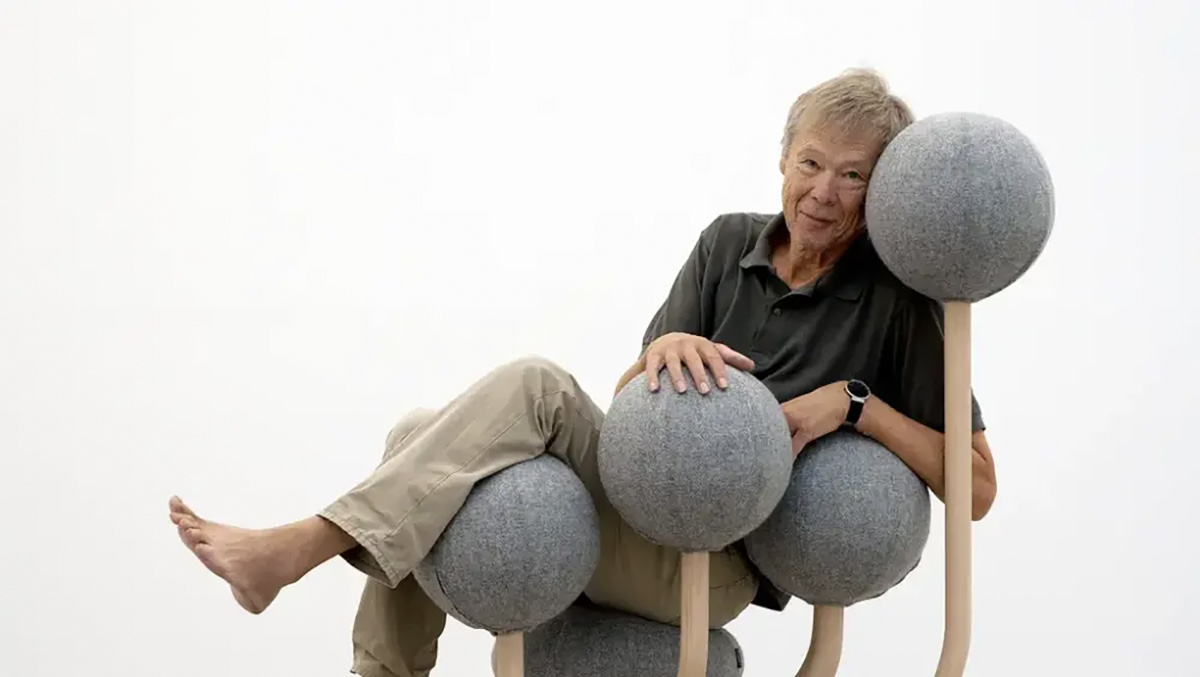
Norwegian designer Peter Opsvik receives the Torsten and Wanja Söderberg Prize 2000
The award committee for the Torsten and Wanja Söderberg Prize decided to award Oslo-based designer Peter Opsvik this year’s prize of SEK 500,000. The prize was presented at a ceremony at the Röhsska Museum in Gothenburg on 3 November. From 2 September to 5 November, the museum showed a major exhibition of Opsvik’s work.
The award committee’s motivation:
Peter Opsvik receives the prize for his pioneering, mobile and adaptable furniture, and because, from a playful, bold and deeply humane starting point, he has continually succeeded in renewing the ergonomics and aesthetics of long-term sitting.
Started as an industrial designer
Peter Opsvik was born in 1939. He trained at the Bergen School of Arts and Crafts (1959–63) and took his diploma in Oslo at the National College of Art and Design (Statens Håndverks- og Kunstindustriskole, 1963–64). He also studied at the Volkwangschule für Gestaltung in Essen (1970). Opsvik began his career as an industrial designer at Tandbergs Radiofabrikk in Oslo (1965–70). Since 1970 he has worked as a freelance furniture designer in Oslo.
Breakthrough with Tripp Trapp and Balans
The adaptable children’s chair Tripp Trapp became Opsvik’s first well-known design success, with more than three million sold since 1972. His definitive breakthrough came with the introduction of the ergonomic Balans concept in 1979, developed by Hans Chr. Mengshoel. Balans, an attempt to combine the best of European and Japanese sitting culture, overturned all previous ideas about sitting. The principle is to create more active sitting by opening the hip angle and transferring part of the load from the back to the legs. During the 1980s and 1990s Peter Opsvik applied this principle in several acclaimed chair models, including Variable (1979), Gravity (1983) and Thatsit (1991).
Inspired by other cultures
Movement and varied sitting positions are also the theme of his other chairs. All of them are innovative and individual: the saddle chair Capisco (1984); Flysit (1990), which rocks on coil springs; Actulum (1995), a small, elegant rocking chair; and most recently Swing, a hanging chair in several versions inspired by Mexican Indigenous culture.
Sound pictures
In addition to his chairs, Opsvik has designed a solar-powered electric car (Butterfly), a series of wooden cabinets and so-called sound pictures, which work both as wall decorations and as musical instruments. Peter Opsvik is also active as a musician in the Christiania Jazzband.
By Editorial Team, ScandinavianDesign.com

Röhsska museet
Vasagatan 37-39, SE-400 15 Göteborg
More Torsten & Wanja Söderberg Awards:

Brynjar Sigurðarson receive Torsten and Wanja Söderberg Prize 2018
The Torsten and Wanja Söderberg Prize 2018 goes to the Icelandic designer Brynjar Sigurðarson Röhsska …

Daniel Rybakken Receive the Torsten and Wanja Söderberg Prize 2017
Daniel Rybakken receive Torsten and Wanja Söderberg Prize 2017 Daniel Rybakken, photo credit Kalle Sanner. …

Torsten and Wanja Söderberg Prize 2016 – Margrethe Odgaard
Danish textile designer Margrethe Odgaard receive Torsten and Wanja Söderberg Prize 2016 The Röhsska Museum …
Ilkka Suppanen @ Design Museum 2016
The Röhsska Museum award committee for the Torsten and Wanja Söderberg Prize, funded by the …

Ilkka Suppanen receive Torsten & Wanja Söderberg Prize 2015
Finnish designer Ilkka Suppanen receive Torsten and Wanja Söderberg Prize 2015 The Röhsska Museum award …
Nordic Design Today 2013 @ Vandalorum
Exhibition of the World’ s Largest Design Prize at Vandalarum VANDALORUM is honared to …