
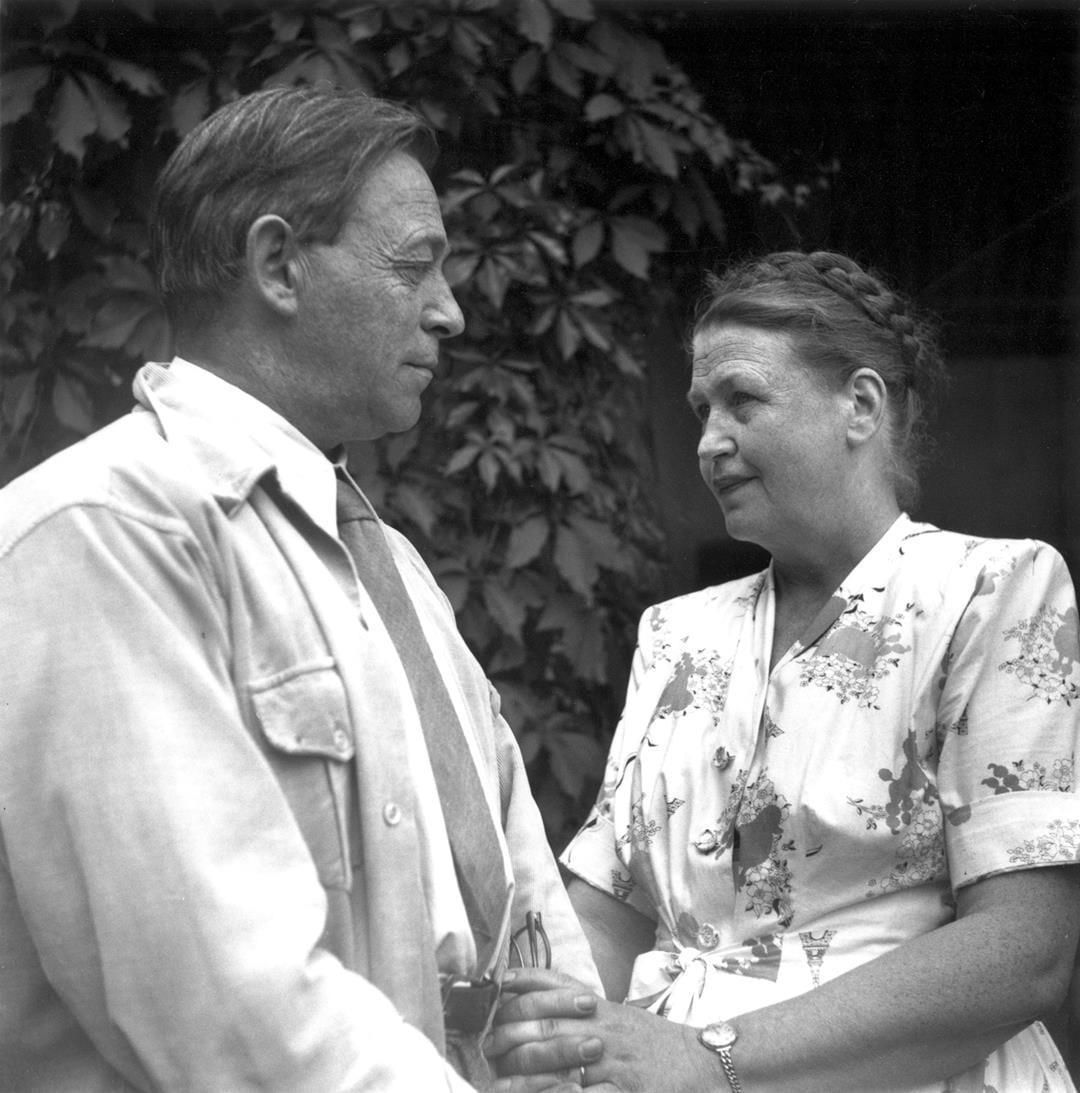
Aino Aalto (born Aino Marsio, 1894–1949) was an architect and designer who co-founded Artek, won the Milan Triennale with her pressed glass designs for Iittala, and practised architecture at the same level as her husband Alvar. That she is consistently less known than him reflects a historical imbalance in how collaborative partnerships are attributed — not a difference in the scale of her contribution.
Training and Early Career
Aino Marsio studied at the Helsinki University of Technology, graduating as an architect in 1920 — among a small number of women to complete architectural training in Finland in that era. She joined Alvar Aalto’s office in 1924 and married him the same year. Their personal and professional partnership was immediate and sustained: from the mid-1920s through to Aino’s death in 1949, the two worked together on architectural commissions, interior design and product design in a collaboration that makes individual attribution difficult and somewhat artificial.
Bölgebreis — A Glass Design That Won the Triennale
The Bölgebreis pressed glass series, designed by Aino Aalto for Iittala and launched in the early 1930s, is her most widely recognised independent contribution. The series — drinking glasses, bowls and serving pieces defined by a ribbed surface pattern that catches and refracts light — won gold medals at the Milan Triennales of 1936 and 1937. The ribbed pattern was not merely decorative: it strengthened the glass structure and gave the pieces a tactile quality that made them easier to hold. Bölgebreis remains in production at Iittala today, nearly ninety years after its introduction.
Artek — A Company Built Together
In 1935, Aino and Alvar Aalto co-founded Artek with Maire Gullichsen and Nils-Gustav Hahl. The company was conceived simultaneously as a manufacturer, retailer and cultural institution — a place that would sell well-designed furniture and objects while also hosting exhibitions and promoting modern design education. Aino served as Artek’s managing director from its founding until her death, taking primary responsibility for the company’s day-to-day operations, commercial relationships and interior design commissions. Her practical leadership was foundational to Artek’s survival through the difficult years of the late 1930s and the Second World War.
Architectural Practice
Aino Aalto’s architectural contribution is the most difficult to separate from her husband’s, given the integrated nature of their practice. She worked on the Villa Mairea, the Finnish Pavilion for the 1937 Paris World’s Fair and numerous residential and interior commissions. Archival research in recent decades has established that her role extended beyond project management into design authorship — though the precise attribution of specific decisions remains contested. What is clear is that the Aalto office produced its work as a collaborative enterprise in which Aino’s architectural judgement was central.
Interior Design and the Domestic Scale
Aino Aalto had a particular interest in interior design and the design of domestic environments. Her work in this area — the specification of furniture, textiles, lighting and objects for residential and hospitality interiors — demonstrated an ability to compose spaces that felt unified without feeling designed. Her interiors typically mixed Artek furniture with pieces selected from other sources, an approach that reflected the same antihierarchical sensibility visible in Josef Frank’s domestic philosophy.
Legacy
Aino Aalto died in Helsinki in 1949, aged 54. Her death preceded by decades the period in which design historians began to pay systematic attention to the contributions of women designers who had worked alongside more publicly celebrated male partners. The Bölgebreis series ensures that her work remains visible in a very direct sense — it is in daily use in homes and restaurants across the world. Her role at Artek has been more fully documented in recent years, and the company’s current owners have made efforts to acknowledge her foundational contribution.