
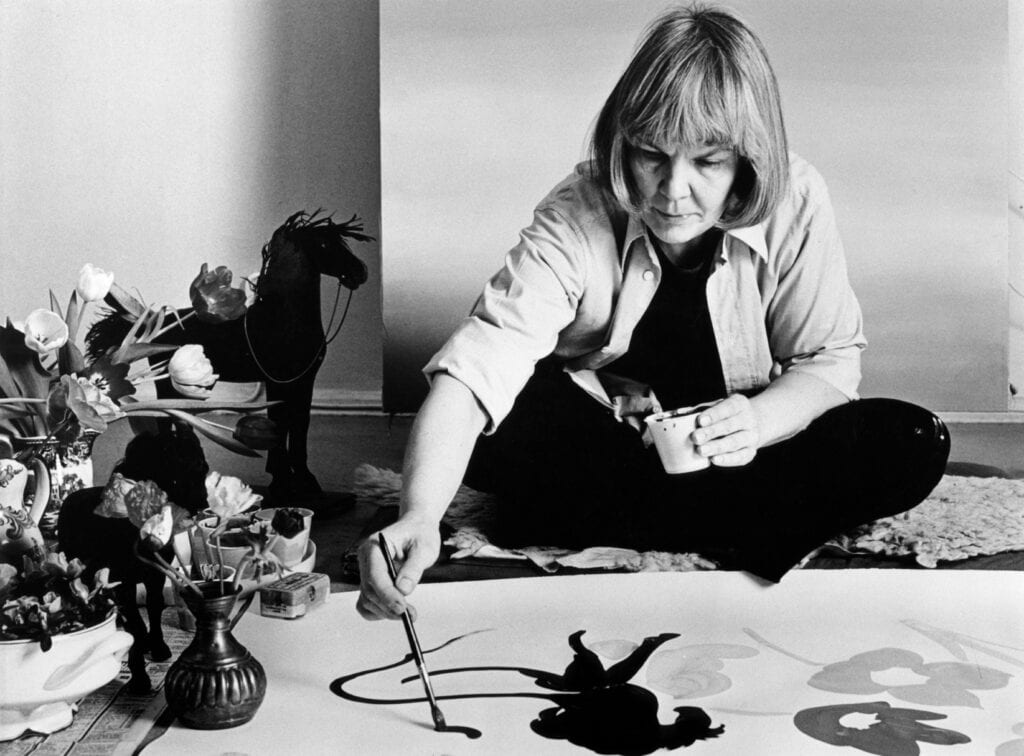
Maija Isola (1927–2001) was the defining pattern designer of postwar Finnish textile production. Over a career spanning four decades, primarily in collaboration with Marimekko, she created more than 500 printed fabric designs that fundamentally altered how textiles were conceived, produced and used. Her work — bold, graphic, unapologetically colourful — broke with the decorative conventions of mid-century fabric design and established a visual language that remains immediately recognisable today.
Training and Formation
Isola was born in Riihimäki, a manufacturing town in southern Finland known for its glass production, in 1927. She studied painting at Helsinki’s Central School of Industrial Design (Taideteollinen korkeakoulu), graduating in 1949. Her training was in fine art rather than applied design — a distinction that would prove significant. Where many textile designers of the period approached pattern as a problem of coordinated repeat and restrained ornament, Isola treated fabric as a surface for painterly expression. Her early work shows an engagement with abstraction, gestural mark-making and a willingness to let accident and improvisation shape the final image.
Marimekko and the Radical Reorientation of Textile Design
Isola joined Marimekko in 1951, two years after the company’s founding by Armi Ratia. Marimekko was established with the explicit intention of producing textiles that rejected prevailing taste — both the fussy florals of traditional fabric design and the geometric abstraction that dominated progressive Scandinavian work in the early 1950s. Ratia recognised in Isola a designer whose approach aligned with this ambition. The partnership between designer and manufacturer would prove exceptionally productive: Isola remained with Marimekko until 1987, with a brief interruption in the early 1960s, and her designs form the core of the company’s identity.
Her early patterns for Marimekko — designs such as Lumimarja (1956) and Kivet (1956) — demonstrate an immediate departure from contemporary norms. The motifs are large-scale, often filling the width of the fabric. Colour is applied in flat, unmodulated areas without shading or tonal variation. The effect is graphic rather than decorative, more akin to screenprinting or poster design than to conventional textile pattern. This approach required technical adaptation: Marimekko developed new printing processes to accommodate Isola’s designs, moving away from fine roller printing toward screen printing methods that could handle bold, simplified forms.
Unikko and the Rejection of Floral Convention
The Unikko pattern, designed in 1964, is Isola’s most widely known work and among the most recognisable textile designs of the twentieth century. The story of its creation is well documented: Armi Ratia had declared that Marimekko would not produce floral patterns, considering them old-fashioned and sentimental. Isola’s response was to create a floral that could not be dismissed on those grounds — a poppy rendered at enormous scale, reduced to essential forms, printed in saturated colour combinations that emphasised graphic impact over botanical accuracy.
Unikko succeeded precisely because it acknowledged the history of floral textile design while refusing its conventions. The pattern is immediately legible as a flower, but it operates through silhouette, flat colour and rhythmic repeat rather than through realistic depiction. It can be read as decoration or as abstraction depending on viewing distance and context. This ambiguity — the pattern’s ability to function simultaneously as recognisable motif and as pure graphic form — accounts for its sustained appeal. Unikko has remained in continuous production since 1964 and has been applied to contexts far beyond fabric: ceramics, homeware, packaging, fashion accessories. It has become synonymous with Marimekko and, by extension, with a particular vision of Finnish design — optimistic, bold, democratically accessible.
Range and Formal Vocabulary
While Unikko dominates popular recognition, Isola’s broader output demonstrates considerable range. Her patterns include geometric abstractions (Lokki, 1961), stylised natural forms (Kaivo, 1964), folk-art references (Kaksoset, 1957), and purely graphic compositions (Silkkikuikka, 1961). What unifies this diversity is a consistent approach to scale, colour and composition. Isola worked at large format — her patterns are intended to be read across metres of fabric, not as small repeating units. She favoured primary colours and high-contrast combinations, often restricting individual designs to two or three hues. Her compositions are structured but not rigid, allowing for variation and incident within an overall geometric or organic framework.
This formal vocabulary reflected broader shifts in postwar design culture — a move away from the restrained good taste of early modernism toward something more exuberant and expressive. Isola’s work paralleled developments in graphic design, pop art and the international youth culture of the 1960s. Marimekko fabrics, worn as dresses or used as furnishing textiles, became associated with a progressive, informal lifestyle — a rejection of bourgeois decorative conventions in favour of colour, pattern and visual pleasure.
Working Method and Collaboration
Isola’s designs originated in painting and drawing, translated to fabric through a process that involved substantial technical collaboration. She worked with Marimekko’s in-house printing specialists to develop colour separations, test printing techniques and resolve production challenges. The scale and boldness of her patterns required manufacturers to adapt their equipment and processes — standard textile printing methods were inadequate for her ambitions. This iterative relationship between designer and production team was central to the work’s realisation. Isola’s patterns exist as they do not solely because of her vision but because Marimekko committed to building the industrial capacity to produce them.
Later Career and Legacy
Isola’s most prolific period was the 1950s through the 1970s. Her output slowed in the 1980s, and she retired from Marimekko in 1987. She continued to work independently, producing paintings and limited-edition prints, until her death in 2001. Her daughter, Kristina Isola, also became a textile designer and collaborated with her mother on several Marimekko patterns in the 1970s.
The persistence of Isola’s work in production and in cultural memory is remarkable. Marimekko continues to print Unikko, Kivet, Lokki and dozens of other Isola designs, with only minor colour variations from the originals. These patterns appear on clothing, bags, tableware and furnishing fabric — contexts Isola could not have anticipated but which demonstrate the adaptability of her graphic approach. Museums internationally hold examples of her work; the Design Museum in Helsinki maintains a substantial archive. Her influence extends beyond Marimekko: contemporary textile designers working in bold, graphic pattern cite her as a foundational reference.
What distinguishes Isola’s legacy is her demonstration that textile design could be both commercially successful and artistically uncompromising. She proved that patterns need not be timid, that colour could be used with confidence, and that large-scale graphic form could function as effectively on fabric as in any other medium. These principles remain active in Finnish design and in textile production internationally.
All design news by Marimekko:

Marimekko Syksy Glassware Collection by Matti Klenell Captures Nordic Autumn
The Syksy collection is a series of glassware for the set table that plays with …

Artek + Marimekko Collection Launch
The exhibition is open from September 5th until October 4th, 2025 during the store opening …

Artek x Marimekko – A 90-Year Celebration of Design @ 3daysofdesign
Artek x Marimekko – A 90-Year Celebration of Design Artek’s 90th anniversary celebrations continue with …
Marimekko Artist Series 2025 design by Petra Börner
Marimekko has always worked with artists Since 1951, we’ve been refining the art of printmaking, …

Bukowskis and Marimekko launch a unique anniversary auction
The Artists Who Shaped Us The Finnish design house Marimekko turns 70 this year. To …

Flower designed by Carina Seth Andersson – Marimekko
A timeless gift idea for new graduates and summer celebrations: New Marimekko vase Flower designed …

Finnair and Marimekko launch design collaboration
Finnair and Finnish design house Marimekko are teaming up to enhance the air travel experience …

Kivikko design by Ilkka Suppanen for Marimekko
Well suited for play and relaxation Kivikko is a social piece of furniture in the …

Maija Isola – Finnish Textile Designer
Maija Isola (1927–2001) was the defining pattern designer of postwar Finnish textile production. Over a …