
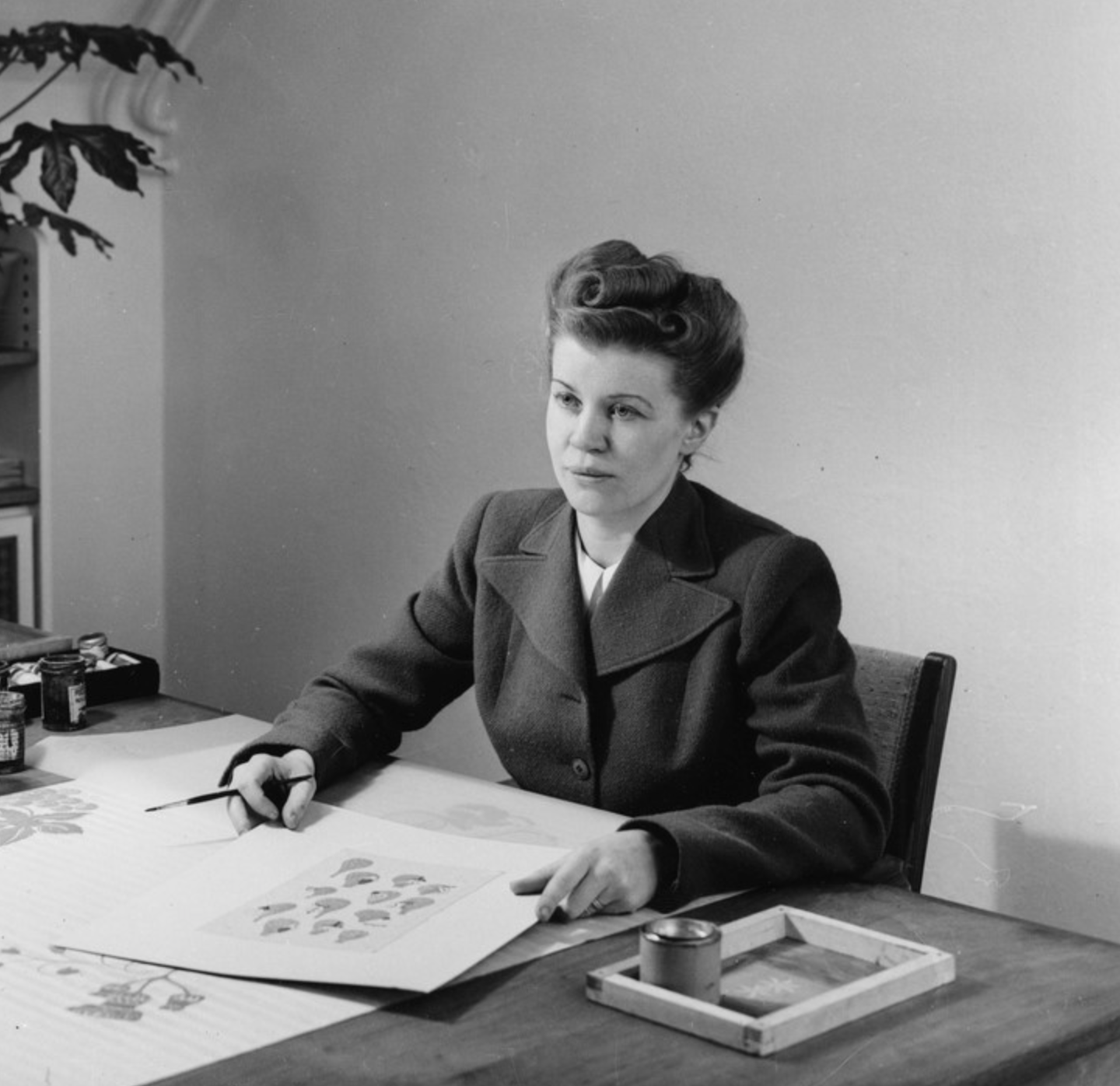
Astrid Sampe (1909–2002) was one of the most influential textile designers in Swedish design history.
As head of Nordiska Kompaniet’s Textile Chamber — Textilkammaren — for 35 years, she shaped how modern textiles were made, distributed and understood in Sweden and beyond.
Education and Early Career
Sampe studied at Konstfack in Stockholm and later at the Royal College of Art in London. In 1935 she joined Nordiska Kompaniet (NK), Sweden’s leading department store, as a textile designer. By 1937 she had been appointed head of the newly established textile department, Textilkammaren — a position she held until its closure in 1971.
Textilkammaren as a Creative Hub
Under Sampe’s direction, NK’s textile department became a meeting point for some of the most significant designers, architects and artists working in Sweden. She brought in Arne Jacobsen from Denmark, and connected Swedish designers Viola Gråsten and Stig Lindberg to the department’s work — a rare example of curatorial thinking applied to industrial textile production.
International Reach
Sampe’s work reached beyond Sweden early. She participated in the World’s Fair in Paris in 1937, and in 1939 contributed to the design of the Swedish Pavilion at the New York World’s Fair alongside architect Sven Markelius. She later established partnerships with Knoll International in New York and Donald Brothers in Dundee, placing Swedish textile design in an international commercial context.
Innovation and Signature Works
Sampe was the first Swedish designer to experiment with fibreglass cloth, and among the first to explore computer-generated patterns. In 1955, her Linnelinjen collection — shown at the Helsingborg exhibition — became a major commercial and critical success. Among its designs, Perssons Kryddskåp (dedicated to ceramic designer Signe Persson-Melin) remains in production with Almedahls today. Other textile designs including Liljerand, Liljeruta and Versailles were produced for Kasthall and Almedahls. The 1954 Signerad Textil project — a collaboration between twelve Swedish artists printed by Ljungbergs Textiltryck in Floda — stands as one of her most ambitious curatorial efforts.
Later Work and Legacy
When Textilkammaren closed in 1971, Sampe established her own studio in Stockholm and continued working as a consultant. She was elected Honorary Member of the Royal Designers for Industry in London in 1949, and received a gold medal at the Milan Triennale in 1954. Several of her textile designs remain in production. Her philosophy — summed up in the phrase “Order is freedom” — defined an approach that balanced geometric clarity with warmth and material intelligence.