
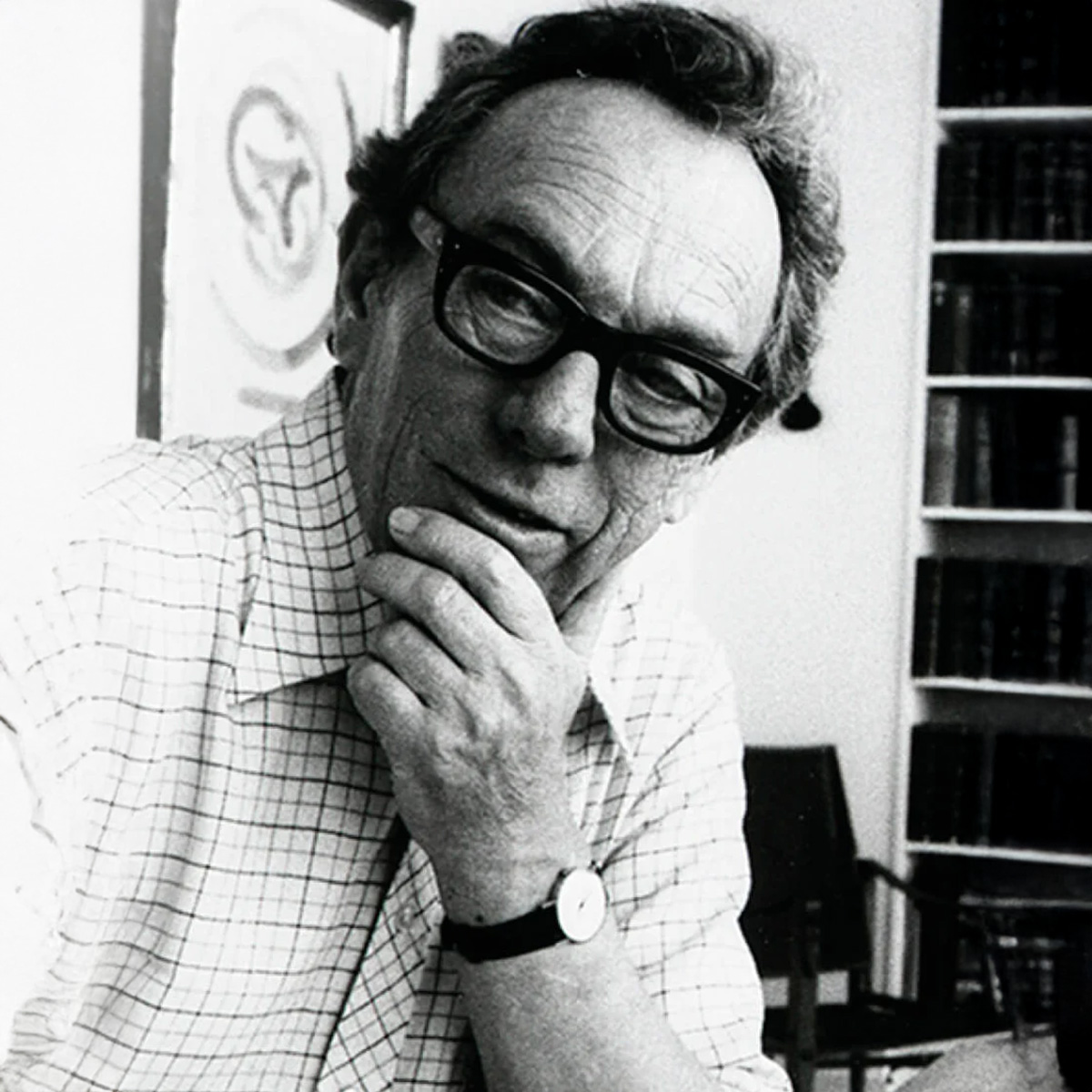
Henning Koppel (1918–1981) was a Danish sculptor and designer whose free, organic forms in silver transformed Georg Jensen‘s output and helped define what became known internationally as Danish design. Across four decades he produced jewelry, hollowware, cutlery, porcelain, glass and clocks — a range of work remarkable for both its volume and its consistency.
Koppel left secondary school in 1936 for the sculpture programme at the Royal Danish Academy of Fine Arts under Einar Utzon-Frank, later studying at the Académie Ranson in Paris. Of Jewish descent, he and his family fled to Sweden in 1943 to escape the German occupation and its persecution of Danish Jews, and spent the war years in Stockholm working as a draftsman and selling watercolors. There, Georg Jensen’s manager Anders Hostrup-Pedersen saw his work and promised him a position once the war ended.
Georg Jensen
Koppel returned to Copenhagen in 1945 and joined Georg Jensen, starting with jewelry in loose, organic forms before moving into hollowware by the late 1940s. His Caravel flatware, launched in 1957 and named after the SAS Caravelle aircraft, is still considered one of the finest modern silver flatware patterns and won the Der Goldene Löffel award in 1963; the New York pattern followed the same year, and the stainless steel Strata pattern in 1975. He stayed with Georg Jensen for the rest of his career, also designing copper cookware at the company’s Hjørring workshop and a weather station released in 1980.
Other materials
Koppel worked across materials well beyond silver: porcelain for Bing & Grøndahl from 1961, glassware for Orrefors, and clocks and lighting for Louis Poulsen.
Recognition and legacy
His work earned three gold medals at the Milan Triennale (1951, 1954, 1957), the Lunning Prize in 1953, and the American Institute of Interior Designers’ International Design Award in 1963. He remained with Georg Jensen until his death in 1981, at 63, and his pieces are held in design museum collections worldwide.