
Wilhelm Kåge (1889–1960) was one of the most important Swedish designers of the 20th century. As artistic director of the Gustavsberg porcelain factory for more than three decades, he brought artists into Swedish industry, designed tableware for ordinary homes and created the celebrated Argenta and Farsta stoneware. He also trained the next generation, above all his successor Stig Lindberg.
Background
Kåge was born Algot Wilhelm Nilsson in Stockholm. He trained as a painter and studied graphic art in Munich, and in the 1910s he became known for his colourful posters for theatres and exhibitions. In 1917 Gustavsberg needed new products for the Home Exhibition at Liljevalchs in Stockholm, organised to bring artists and industry together, and hired the young poster artist. His Liljeblå service – the “workers’ service”, with its blue lily decor – became the factory’s contribution, and the same year he was made artistic director.
Gustavsberg
Kåge set out to master the technical side of ceramics and in 1921–22 made a study trip through Europe and North Africa. Over the following decades he developed around thirty tableware services. The ovenproof Pyro (1929) and the stackable Praktika (1933) followed functionalist ideas of rational production and practical use. The factory’s social mission grew stronger after the consumer cooperative KF bought Gustavsberg in 1937.
Argenta and Farsta
At the Stockholm Exhibition of 1930 Kåge presented two art series that made his name internationally. Argenta – green-glazed stoneware with inlaid silver decoration – was at first thrown by the master throwers Berndt Friberg and Walter Johansson and painted by Kåge himself; as demand grew, a whole team was needed. Farsta, his most exclusive work, explored clays, glazes and decorative techniques in unique pieces made into the 1950s. Later series include the biomorphic Våga and Surrea, of which only a small number of hand-painted pieces were made.
The Gustavsberg studio
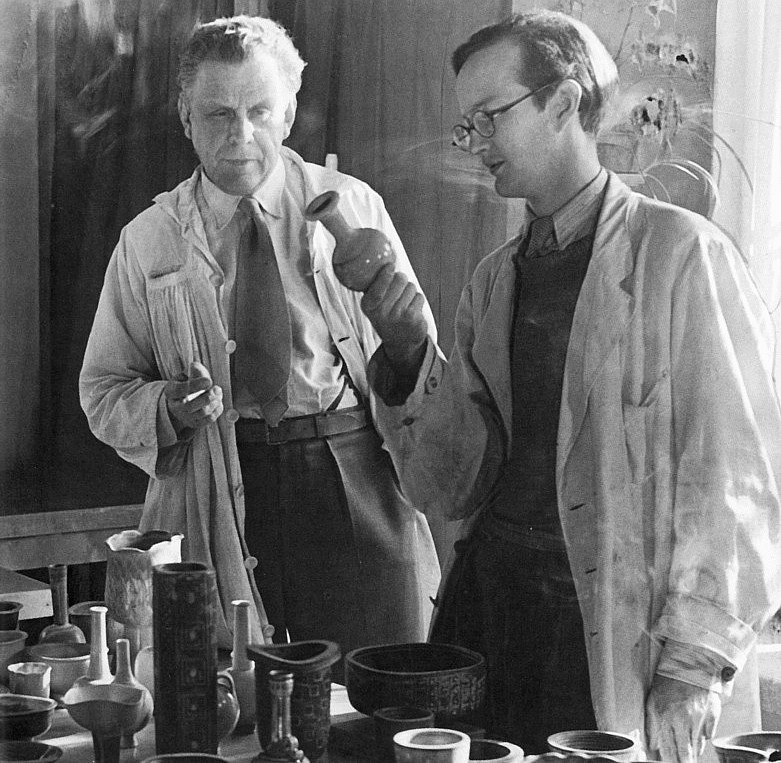
In 1942 Kåge and Stig Lindberg set up G-studion, an experimental studio inside the factory where artists could work freely alongside production. Berndt Friberg worked there too, and the studio became the creative heart of the factory, where Lisa Larson later found her place. Lindberg succeeded Kåge as artistic director in the late 1940s, and Kåge continued to work in the studio until his death in Stockholm in 1960.
Legacy
In 2000, KF donated the Gustavsberg collection to the Swedish state; it is now cared for by Nationalmuseum. Kåge’s work has been shown in exhibitions such as Wilhelm Kåge at the Gustavsberg Porcelain Museum, which included the Argenta series, Farsta stoneware and works by the KAPA partnership, and Wilhelm Kåge & Shōji Hamada – Ceramics Across Borders at Nationalmuseum, which set him beside the Japanese potter. His pieces are also part of a century of Scandinavian ceramics at Rian Designmuseum, and the factory’s history is told in Stig Lindberg 100.
By Editorial Team, ScandinavianDesign.com
Photo: Wilhelm Kåge and Stig Lindberg at Gustavsberg.
More about Wilhelm Kåge
Wilhelm Kåge & Shōji Hamada exhibition @ Nationalmuseum
The spring craft exhibition Wilhelm Kåge & Shōji Hamada Ceramics Across Borders brings together two masters of …
The magic of clay – Scandinavian ceramics through a hundred years @ Rian designmuseum
27 May – 27 August 2023 Modern ceramics contain a variety of expressions – from …
Wilhelm Kåge @ Gustavsberg Porcelain Museum
17 June–3 September 2017 At Gustavsberg Porcelain Museum, Värmdö. Dragonfish and urn, Farsta stoneware, plates …