
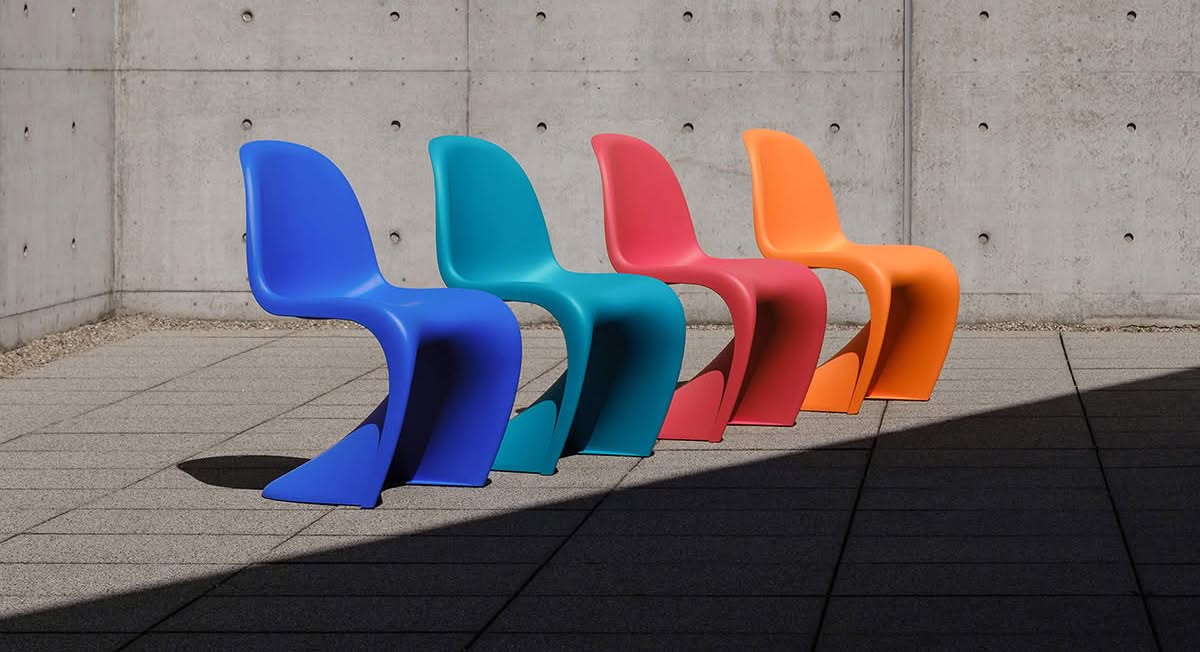
Photo: Design by Verner Panton © Verner Panton Design AG, Photo: Vitra / Clemens Poloczek
Vitra is a Swiss furniture and design company founded in 1950 near Basel by Willi and Erika Fehlbaum. The name comes from the display vitrines their original shopfitting business built — a modest starting point for a company that would go on to shape how the world understands modern furniture. Today it is still family-run: Nora Fehlbaum leads the company as CEO, having succeeded her father Rolf.
From shopfitting business to Herman Miller’s licensee
The turning point came in 1953, when Willi Fehlbaum visited New York and encountered the modernist furniture of Charles and Ray Eames and George Nelson, produced in the United States by Herman Miller. Fehlbaum negotiated a manufacturing agreement, and from 1957 Vitra produced their designs under license across Europe. For its first decade and a half as a furniture maker, Vitra’s identity was built almost entirely on other people’s designs.
Verner Panton and the shift to independent design
That changed in 1967, when Vitra brought Danish designer Verner Panton‘s single-piece plastic cantilever chair into production — the company’s first original product rather than a licensed one. It was a technically difficult chair to manufacture and a commercial risk, but it gave Vitra its own design credentials for the first time. When the Herman Miller licensing agreement ended in 1984, Vitra secured the rights to produce Eames and Nelson designs for Europe and the Middle East itself, completing the shift from licensee to design house.
The 1981 fire and the Vitra Design Museum
A major fire destroyed much of the production facilities at the company’s Weil am Rhein site, just across the German border from Basel, in 1981. The rebuilding that followed turned into an architectural project in its own right: Frank Gehry designed the Vitra Design Museum, completed in 1989 — his first building in Europe — and the campus grew from there into a showcase of contemporary architecture, with later buildings by Zaha Hadid, Tadao Ando and Herzog & de Meuron. A 1953 petrol station by the French designer Jean Prouvé was relocated to the campus in 2003, part of a permanent collection that treats furniture history as something to be preserved and exhibited, not just sold.
Vitra today
Vitra expanded into domestic furnishings with its Home Collection, launched in 2004, and in 2013 acquired the Finnish furniture company Artek, adding Alvar Aalto’s production heritage to its own. The company now operates as both a manufacturer and something closer to a cultural institution — its Weil am Rhein campus draws visitors as an architecture and design destination in its own right, built on a collection that spans Eames and Panton to Jasper Morrison and the Bouroullec brothers.