
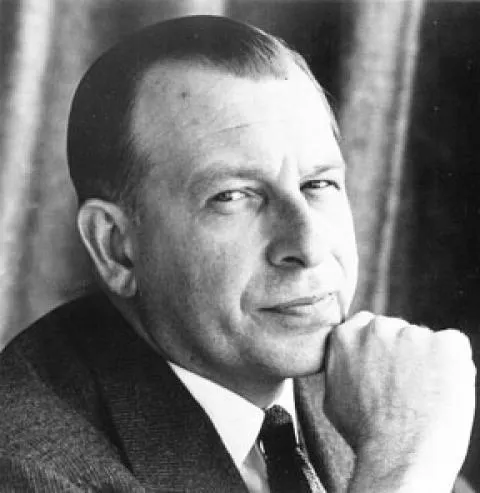
Eero Saarinen (1910–1961) was born in Kirkkonummi, Finland, immigrated to the United States at thirteen, and died at fifty-one of a brain tumour, leaving behind an architectural portfolio that remains among the most formally varied of the twentieth century. He designed the Gateway Arch in St. Louis, the TWA Flight Center at JFK, Washington Dulles Airport, and the US Embassy in London — buildings that have no obvious formal relationship to each other and no obvious relationship to his furniture: the Womb Chair, the Tulip chair and table, and the Pedestal Collection, all produced by Knoll and still in production today.
Cranbrook, Eames and a Finnish-American Education
Saarinen grew up at the Cranbrook Academy of Art in Bloomfield Hills, Michigan, where his father Eliel — one of Finland’s most celebrated architects — had become president and chief designer. The Cranbrook community in the 1930s was an extraordinary concentration of design talent: among Eero’s contemporaries there were Charles Eames, Ray Kaiser (who would marry Eames), and Florence Schust (who would marry Hans Knoll and run the Knoll furniture company for which Saarinen would produce his most famous pieces). After studying sculpture at the Académie de la Grande Chaumière in Paris in 1929, Saarinen completed his architectural degree at Yale in 1934 and returned to Cranbrook to teach and practise.
MoMA 1940 — Furniture Before Architecture
In 1940, Saarinen and Charles Eames entered the Museum of Modern Art’s ‘Organic Design in Home Furnishings’ competition and won first prize in all categories — their moulded plywood chair designs establishing both designers as significant figures in the American modern furniture movement. The competition and its aftermath cemented the friendship between Saarinen and Florence Schust, who would become Florence Knoll; the relationship between Saarinen and the company she ran would prove the most productive commercial relationship of his career. Saarinen became a naturalised US citizen the same year.
Womb Chair — Furniture as Comfort
Florence Knoll’s commission to Saarinen was specific: she wanted ‘a chair you could really curl up in.’ His response was the Womb Chair (1948) — a wide, fibre-glass shell upholstered in foam rubber and fabric, mounted on slender steel legs, designed to accommodate the full range of postures a person actually assumes in a chair rather than the upright sitting position that most chairs demand. The Womb was an immediate commercial and critical success and remains in production at Knoll today. It established the formal and material language — organic shell, thin structural support — that Saarinen would develop through his subsequent furniture work.
Pedestal Collection — Solving the ‘Slum of Legs’
The Pedestal Collection (1958), also for Knoll, is Saarinen’s most formally radical furniture: a series of chairs and tables mounted on a single aluminium pedestal base, eliminating what he described as the ‘slum of legs’ that complicated the visual landscape of most interiors. The Tulip chair — its moulded fibreglass shell in an organic tulip form above the single trumpet base — became the defining image of the collection and one of the most reproduced furniture silhouettes of the twentieth century. Stanley Kubrick used Pedestal pieces in the sets of 2001: A Space Odyssey and A Clockwork Orange. The collection remains in full production at Knoll.
Gateway Arch and the Architecture of Monument
Saarinen won the 1948 competition for the Jefferson National Expansion Memorial in St. Louis — the commission that would produce the Gateway Arch. The story is well known: when the competition results were announced, Eliel Saarinen was initially congratulated, only for it to emerge that the winning entry was by his son. The Arch — a catenary curve in stainless steel, 192 metres at its apex — was completed in 1965, four years after Saarinen’s death. It is the tallest man-made national monument in the United States and the most formally singular structure of its era.
TWA Flight Center and Dulles — Architecture in Motion
The TWA Flight Center at John F. Kennedy Airport (1962, completed posthumously) is the building most consistently associated with Saarinen’s mature architectural vision: a concrete shell structure whose wing-like rooflines express movement and departure with a directness that few airport buildings have approached. The interior — red-carpeted, organically curved, dramatically lit — was designed as a total experience. It was designated a New York City landmark in 1994 and reopened in 2019 as the TWA Hotel, with Saarinen’s furniture designs included in its interiors. Washington Dulles International Airport (1962), also completed posthumously, was the world’s first jet airport and demonstrated the same mastery of expressive structural form at a larger civic scale.
A Deliberate Refusal to Repeat
What is most striking about Saarinen’s career, viewed whole, is the deliberate absence of a signature style. The Gateway Arch, the TWA Terminal, the CBS Building (his only skyscraper), the Miller House in Columbus Indiana, and the US Embassy in London share no obvious formal language. Saarinen’s position — articulated in his writings and in the accounts of collaborators — was that each commission required its own solution, and that recycling formal decisions across projects was a failure of architectural intelligence. He died in Ann Arbor on 1 September 1961, aged 51, while overseeing the completion of a music building at the University of Michigan. He was posthumously awarded the Gold Medal of the American Institute of Architects in 1962.