
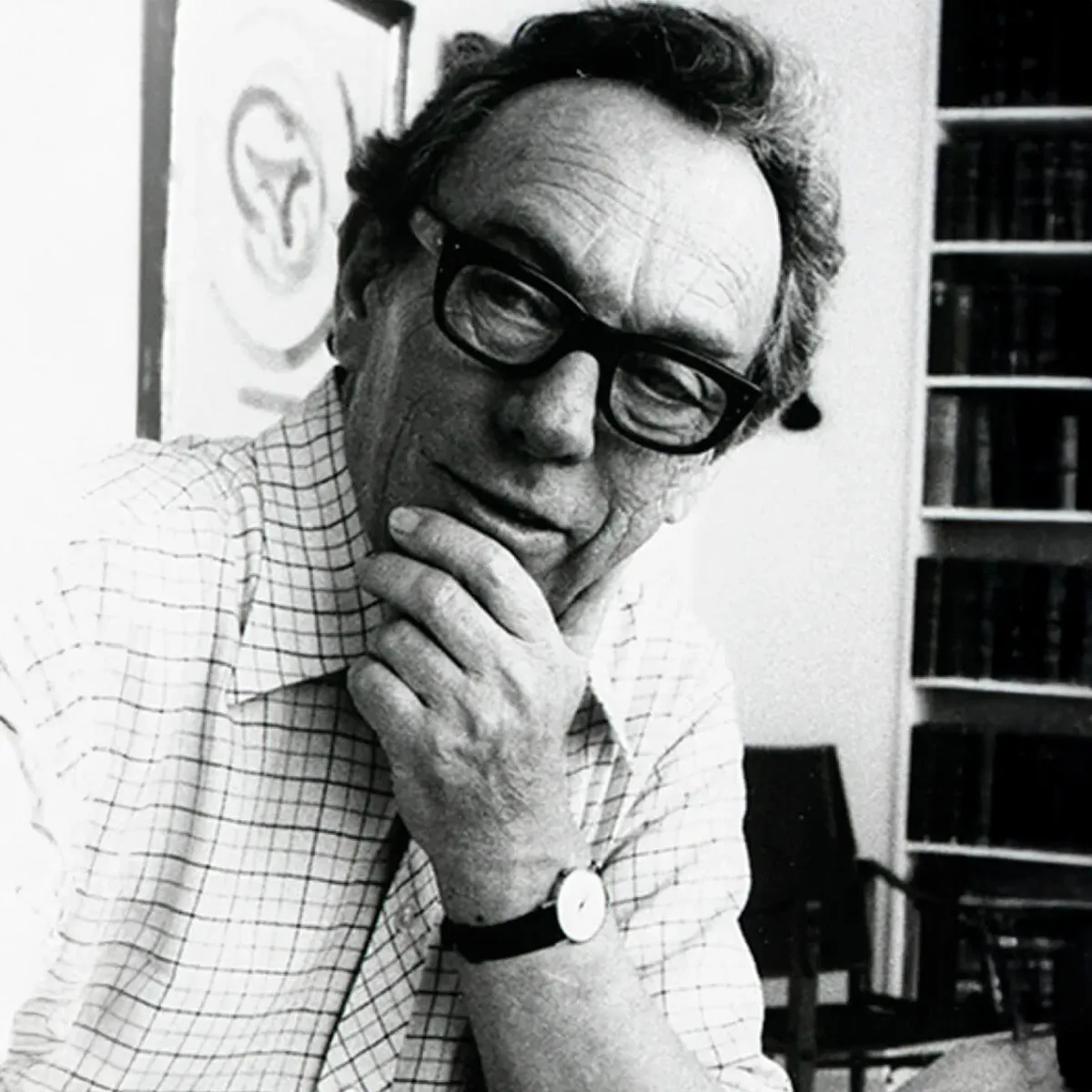
Henning Koppel: Silver, Porcelain and Glass — A Multi-Decade Career Across Georg Jensen, Bing & Grøndahl and Orrefors
Henning Koppel (1918–1981) was a Danish artist and designer whose sculptural approach to silver transformed Georg Jensen’s output and helped define what became known internationally as Danish design.
Across four decades, he produced jewelry, hollowware, cutlery, porcelain, glass and clocks — a range of work remarkable for both its volume and its consistency.
Early Training and Wartime Exile
Koppel left high school before his finals in 1937 and was admitted to the sculptors’ course at the Royal Academy of Fine Arts in Copenhagen, later continuing his studies at the Académie Ranson in Paris. When Denmark was occupied during the Second World War, the Koppel family fled to Stockholm in October 1943. There, he worked primarily as a draughtsman, selling watercolours of shop fronts to their owners to make a living. It was in Stockholm that he encountered Anders Hostrup-Pedersen, the new manager of Georg Jensen, who recognised the quality of Koppel’s work and expressed his intention to bring him in once the war was over.
Georg Jensen — A Defining Partnership
The two met again in Copenhagen in 1946, and what followed was one of the most productive designer-manufacturer relationships in Scandinavian design history. Koppel’s early work for Georg Jensen began with jewelry — necklaces and bracelets of flowing, organic form that drew on his training as a sculptor. By the late 1940s he had moved into hollowware: pitchers, dishes and serving pieces with a sculptural quality unlike anything the Jensen silversmith had produced before. His Caravel flatware pattern, introduced in 1957 and named after the SAS Caravelle aircraft, is considered among the finest silver flatware patterns of the modern era. It won the Der Goldene Löffel award in 1963.
Working Across Materials
Koppel’s output extended well beyond silver. He designed china for Bing & Grøndahl from 1961, and glass for Orrefors from 1971, bringing the same sculptural discipline to each material. At Georg Jensen’s factory in Hjørring, he designed copper cookware with silver-coated interiors. His first clock was produced by Louis Poulsen; later clock designs and a weather station were produced by Georg Jensen. The weather station, introduced in 1980, became a commercial success in the last year of his life.
Awards and Recognition
Koppel received gold medals at the Milan Triennale in 1951, 1954 and 1957, the Lunning Prize in 1953, and the International Design Award of the American Institute of Interior Designers in 1963. His work is held in museum collections worldwide. He continued designing for Georg Jensen until his death in 1981, aged 63.