

Kaare Klint (1888–1954) is the foundational figure in Danish furniture design. As a designer, he produced a small but precisely resolved body of work that drew on historical precedent to address contemporary function. As a teacher at the Royal Danish Academy of Fine Arts, he formed a generation of designers — among them Ole Wanscher, Mogens Koch and Orla Mølgaard-Nielsen — who would carry his principles through the postwar decades and establish Danish furniture as an international reference.
Background and Training
Klint was the son of the architect Peder Vilhelm Jensen-Klint, best known for the Grundtvig’s Church in Copenhagen. He trained as a painter and architect, establishing a practice that combined architectural commissions with furniture design from the early 1910s. His approach to furniture was shaped by an architectural sensibility: he thought about pieces in relation to the spaces they occupied and the human bodies that used them, rather than as objects to be designed independently of their context.
The Faaborg Museum Chairs — A Method Established
Klint’s chairs for the Faaborg Museum (1914) are among the earliest demonstrations of his method. Commissioned to furnish a new museum on the island of Funen, he designed seating that derived its proportions from systematic measurement of how bodies occupy chairs — seat height, seat depth, back angle, armrest height. This functional anthropometry, combined with references to historical chair types (English Shaker, Egyptian folding chairs), established the approach that would define his subsequent work and his teaching.
The Safari Chair — A Type Perfected
The Safari Chair (1933), produced by Rud. Rasmussen, is Klint’s most widely known piece and the work that best demonstrates his method of working from historical types. Based on the folding safari and campaign chairs used by British officers in colonial contexts — itself derived from ancient Egyptian folding stools — Klint’s version retains the essential structural logic of the original while refining its proportions, improving its materials (ash frame, canvas or leather seat and back) and resolving its joinery with Danish craft precision. The result is a chair that feels both historically grounded and entirely contemporary.
Kunstakademiet and the Klint School
In 1924 Klint was appointed to lead the furniture design programme at the Royal Danish Academy of Fine Arts (Kunstakademiet) in Copenhagen — the first such position in Denmark. His curriculum was distinctive and influential: students were required to undertake systematic study of historical furniture types before designing anything, on the principle that understanding existing solutions was a precondition for improving them. This archaeological approach to design history, combined with rigorous functional analysis, produced designers who knew why furniture was the way it was and how to make it better. The so-called Klint school — the generation trained under him — dominated Danish furniture design through the 1950s and 1960s.
Other Works and Collaborations
Beyond the Safari Chair, Klint’s furniture output includes the Red Chair (1927), the Deck Chair (1933) and the Barcelona Chair — all produced by Rud. Rasmussen, a manufacturer whose commitment to craft production made it an ideal partner for Klint’s quality-focused approach. He also designed lighting, interiors and exhibition installations, always applying the same principle of functional resolution informed by historical understanding.
Legacy
Klint died in Copenhagen in 1954, having established a tradition that shaped Danish furniture design for at least two subsequent generations. His direct students became the designers most associated with the golden age of Danish furniture: Wanscher, Koch, Mølgaard-Nielsen, Hans J. Wegner (who studied at the same institution in the same period, absorbing the same principles). His insistence that good design is achieved through knowledge and discipline rather than inspiration alone remains the most durable element of his legacy.
More design from Kaare Klint:
Authentic and purposeful design crafted to last – Fredericia
Since our establishment in 1911, Fredericia has cultivated a proud tradition of exquisite craftsmanship and …
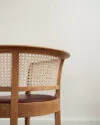
The First Danish Modern Design Classic Turns 110 Years – The Faaborg Chair by Kaare Klint
IN 1914, KAARE KLINT DESIGNED THE FAABORG CHAIR FOR FAABORG MUSEUM, AND SINCE THEN, THE …
The English Chair & The Spherical Bed by Kaare Klint – Carl Hansen & Søn
Introducing The English Chair & The Spherical Bed by Kaare Klint’s masterpieces from the 1930s …

The Klint Chair by Kaare Klint | Fredericia
This year marks the 100th anniversary of the founding of Kaare Klint’s furniture school, the …
Special edition Safari Chair by Kaare Klint – Carl Hansen & Søn
Archetypical design for a modern age Kaare Klint introduced the Safari Chair in 1933 as …
Carl Hansen & Søn launches two geometric coffee tables design by Kaare Klint
Kaare Klint’s significance to Danish furniture design cannot be overstated. Klint was one of the …

Mix Chair & Propeller Stool in new hues – Carl Hansen & Søn
On the 90th anniversary of Kaare Klint’s Mix Chair and Propeller stool, Carl Hansen & …
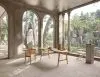
Faaborg Chair design 1914 by Kaare Klint for Carl Hansen & Søn
KK96620 | Faaborg Chair design by Kaare Klint Kaare Klint’s KK9662 Faaborg Chair was designed …
The Legends of Danish Design @ Pushkin State Museum
Legends of Danish design 12.04.2017 – 11.06.2017 On April 12, 2017 “The Legends of Danish …

The Danish Chair @ Design Museum Danmark
The Danish Chair is a wunderkammer of chairs. In the exhibition, Designmuseum Danmark tells the …

Principal furniture work turns 100 – Faaborg Chair by Kaare Klint
It has been called the first modern Danish design classic – and now it reaches …

Kaare Klint — Father of Danish Furniture Design
Kaare Klint (1888–1954) is the foundational figure in Danish furniture design. As a designer, he …