
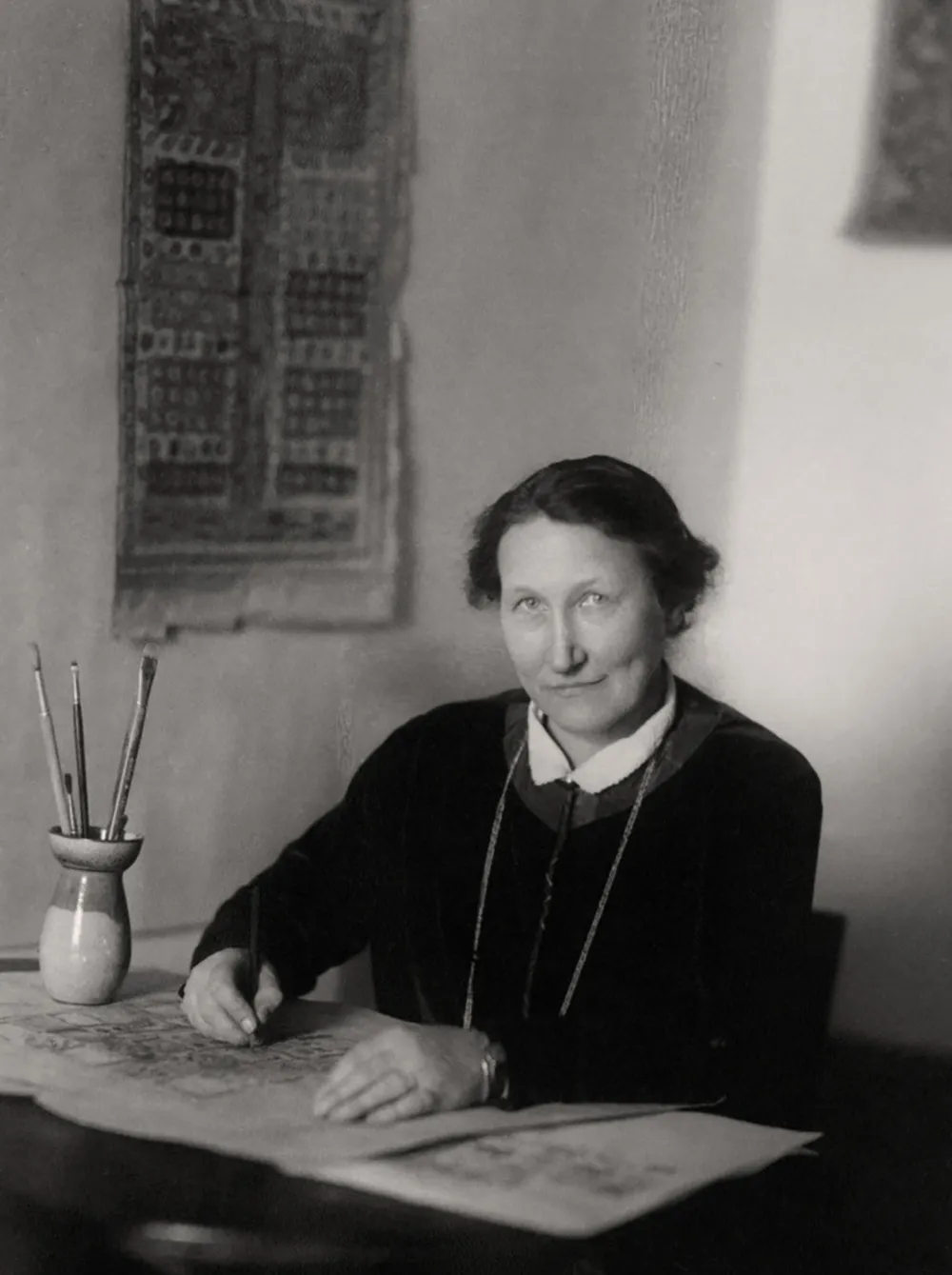
Märta Måås-Fjetterström: The Swedish Textile Master Who Shaped a Century of Weaving
Märta Måås-Fjetterström (1873–1941) stands as one of the most significant figures in modern Swedish textile art.
Her mastery of form, line and composition — rooted in direct observation of nature — transformed decorative weaving into a serious artistic discipline.
In 1919, she established her own weaving workshop in Båstad, a coastal town north of Malmö on the Swedish west coast. For 22 years she led the studio, translating organic forms into rigorous decorative patterns. Her approach was precise: every growing form observed in nature was distilled into ornamental composition, filling the surface with considered intent.
Märta Måås-Fjetterström ran the workshop, known as Strandgården, until her death in 1941 at the age of 68. In 1948, operations moved to a new building in Båstad designed by architects Ivar and Anders Tengbom. The studio did not close with its founder — it continued.
A group of dedicated weavers took responsibility for sustaining her artistic vision. Barbro Nilsson led the studio as artistic director for many years, developing new ideas while maintaining absolute command of technique and colour. Her own works are counted among the workshop’s finest.
Subsequent artists have contributed designs across generations: Marianne Richter, Ann-Mari Forsberg, Barbro Sprinchorn, Kaisa Melanton, Marin Hemmingsson, Ulla Gowenius, and more recently, the painter Ernst Billgren. Together with skilled weavers, the studio continues to produce carpets, art fabrics and tapestries for clients worldwide.
Today, MMF — as the studio is commonly known — remains one of Sweden’s most respected textile producers, working in an unbroken tradition that spans over a century.