
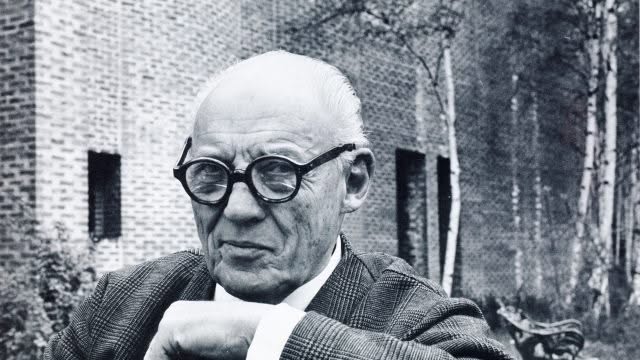
Sigurd Lewerentz (1885–1975) was a Swedish architect whose career spanned nearly seven decades, from the Nordic Classicism of the 1910s to a late, singular body of brick churches that has made him one of the most studied — and least imitated — figures in twentieth-century architecture.
Unlike his contemporary and sometime collaborator Gunnar Asplund, Lewerentz published little, rarely spoke publicly, and left much of his most demanding work to be understood through the buildings themselves.
Early career and the Woodland Cemetery
Born in Bjärtrå in northern Sweden, Lewerentz trained as an architect before winning, together with Gunnar Asplund, the 1915 competition for Stockholm’s Woodland Cemetery (Skogskyrkogården). Lewerentz took the lead on the landscape design, threading paths through the existing pine forest and setting gravestones directly into that terrain rather than imposing a formal cemetery plan on top of it. His own building on the site, the Chapel of Resurrection (1925), is a work of Nordic Classicism — a white-mosaic interior behind a severe, porticoed exterior. The cemetery was inscribed as a UNESCO World Heritage Site in 1994.
Public buildings of the 1930s
Lewerentz served as head architect, again alongside Asplund, of the 1930 Stockholm Exhibition, the event that introduced functionalism to a broad Swedish public — he designed its wing-shaped logo, exhibition stands and pavilions. In the years that followed he completed the National Insurance Board building (1932), where an oval interior courtyard channels daylight through the workspaces, and worked with Erik Lallerstedt and David Helldén on the steel-framed, glass-fronted Malmö Opera (1933).
St Mark’s Church and St Peter’s Church, Klippan
Lewerentz’s late churches are what he is now best known for. St Mark’s Church in Björkhagen (1960) is defined by a dark, almost forbidding brick facade. St Peter’s Church in Klippan (1963), widely considered his masterpiece, goes further still: rough brick surfaces, deliberately uneven floors that pool rainwater near the door, and a font made from a conch shell suspended over the paving rather than set on a pedestal. Both buildings treat material and imperfection as part of the architecture’s meaning, not a flaw to be resolved.
Furniture and the Töreboda chair
Furniture was a minor thread in Lewerentz’s practice, but not an absent one — he designed furniture, fittings and graphics for the 1930 Stockholm Exhibition, and later co-founded a fittings company, Idesta, to produce work for his own buildings. His last design, the Töreboda chair, grew out of an earlier prototype he had built to test the ergonomics of the brick benches in St Peter’s Church, Klippan. Completed in 1974, a year before his death, it was intended for mass production but only a handful of copies were made at the time. The Swedish manufacturer Tallum now produces the Töreboda chair in both varnished pine and electroplated steel.
Legacy
Lewerentz’s reluctance to write or theorise about his own work has made him something of an architect’s architect — studied intensively by other practitioners, the subject of a dedicated exhibition at ArkDes in Stockholm, and cited as a reference point for architects working with brick and raw materials today. His body of work remains small compared to more prolific contemporaries, but few Swedish architects have been returned to as often.