
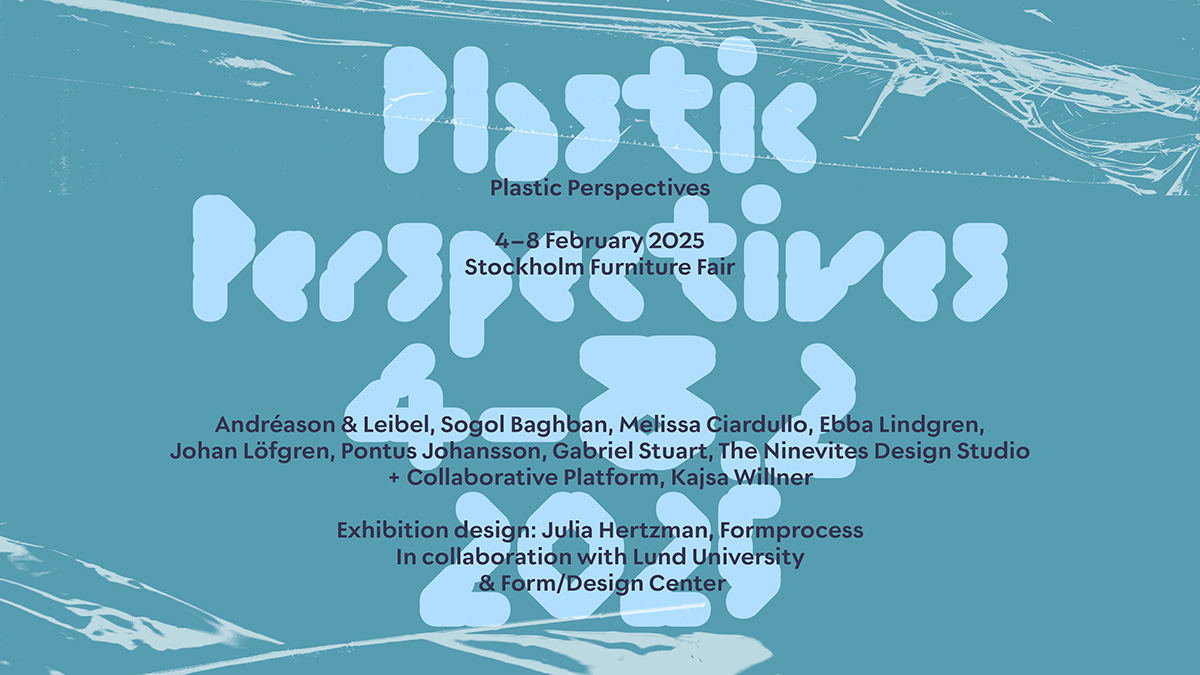
Graphic profile: Daniel Christensen
Thought-provoking exhibition challenges our view of plastic during Stockholm Furniture Fair.
During Stockholm Furniture Fair February 4-8, Plastic Perspectives – an exhibition exploring humanity’s relationship with plastic opens, examining how this material, despite its brief history, has come to play a fundamental role in our modern society. The fair also features two engaging panel discussions where researchers, designers, and industry representatives discuss how plastic can be used more responsibly. After its premiere in Stockholm, the exhibition opens on February 14 at Form/Design Center in Malmö.
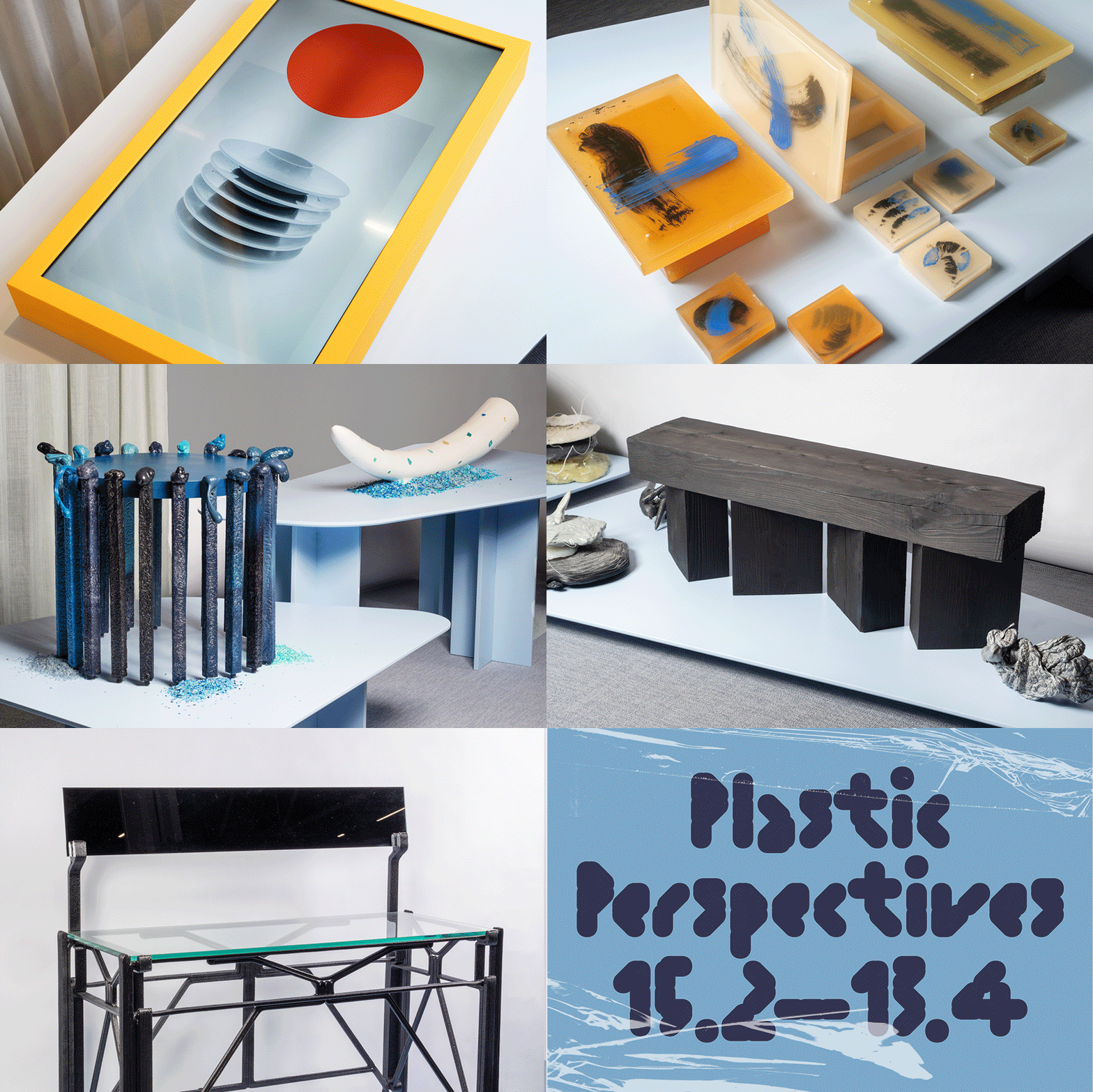
Plastic is a lightweight, inexpensive, and accessible material. But its omnipresence around us raises uncomfortable questions: about overconsumption, littering, and the use of fossil raw materials. About our desire to shape, bend, and color products in endless variations. Through design, art, and architecture, the Plastic Perspectives exhibition examines how, when, and why the material should be used. Today, plastic exists everywhere on Earth, visible even from space, and impossible to completely remove.
“Plastic is a material that both solves and creates problems in today’s society, and this complexity needs to be illuminated for us to handle it more sustainably. In an artistic and communicative way, ‘Plastic Perspectives’ highlights our relationship with plastic and inspires new ways of thinking,” says Anna Gudmundsdottir – project manager, Form/Design Center.
The exhibition is a result of collaboration between Lund University, Form/Design Center, Konstfack, and Formprocess. The goal has been to create dialogue between researchers and design practitioners to explore and communicate about plastic’s role in contemporary society through a co-creative process. Professor Lars J Nilsson explains that design practitioners are a key target group as their profession allows them to influence, question, and reflect on issues such as circular design, resource efficiency, and innovation related to products and built environments.
“Our plastic research indicates that changes are needed across all sectors, focusing on smart plastic use, renewable resources, and circular systems. It has been incredibly rewarding to see designers engage with our results and then transform the research into everything from sculptures, furniture, and installations,” says Lars J Nilsson – Professor of Environmental and Energy Systems at Lund University.
The exhibition is a result of collaboration between Lund University, Form/Design Center, Konstfack, and Formprocess. The goal has been to create dialogue between researchers and design practitioners to explore and communicate about plastic’s role in contemporary society through a co-creative process. Professor Lars J Nilsson explains that design practitioners are a key target group as their profession allows them to influence, question, and reflect on issues such as circular design, resource efficiency, and innovation related to products and built environments.
“Our plastic research indicates that changes are needed across all sectors, focusing on smart plastic use, renewable resources, and circular systems. It has been incredibly rewarding to see designers engage with our results and then transform the research into everything from sculptures, furniture, and installations,” says Lars J Nilsson – Professor of Environmental and Energy Systems at Lund University.
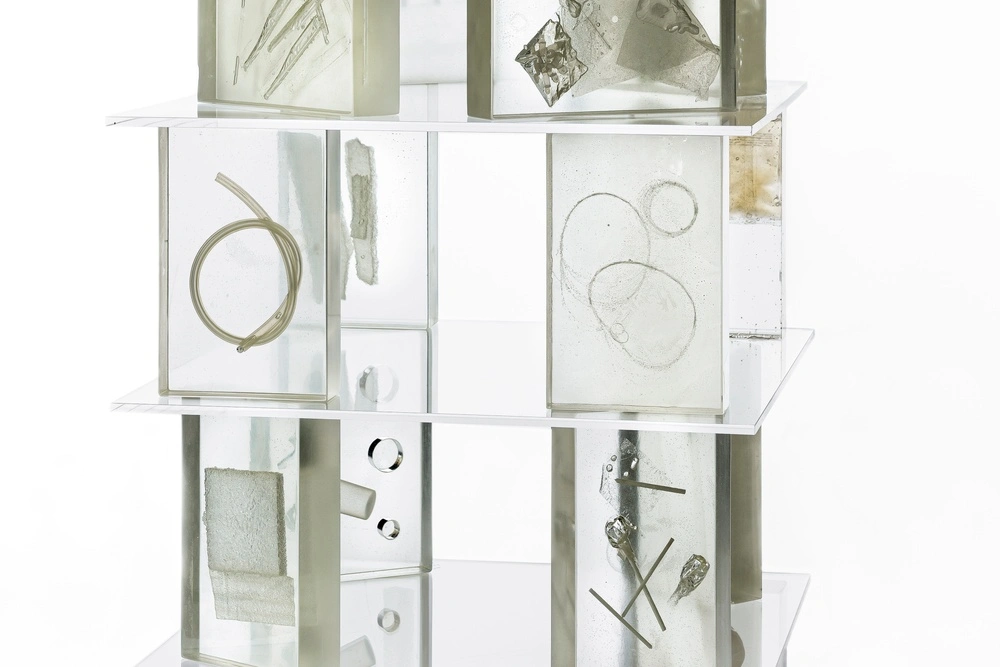
REDUCE by Kajsa Willner is one of the works in the exhibition. Photo Kennet Ruona
Plastic Perspectives builds on years of plastic research from Lund University and examines our often uncritical relationship with the material. It emphasizes that everything produced must be managed. We are challenged to change our view of plastic, from something ugly that is often discarded, to a material that can be refined through craftsmanship methods and become objects worth preserving. It reflects on humanity’s need to color plastic in thousands of colors – despite knowing that colors and additives make it harder to recycle. Plastic Perspectives also examines reuse and recycling and takes a critical look at contemporary systems for agriculture and food production. Ten design practitioners approach current research through various methods and expressions.
The exhibition’s themes are also visible in its design, expressing that plastic can have different structures, colors, and glosses. The textile elements consist of refined industrial plastic waste and borrowed textiles made from recycled polyester. The podiums are painted with plastic-free paint, and the removable floor incorporates bio-based plastic.
“The design and several of the works explore plastic in relation to materiality, craftsmanship, and traditions. A driving force has been to invite reflection on how we expect plastic to look and behave. The invisible plastic is also important to highlight, particularly in the built environment where various plastics are components in many materials,” says exhibition designer and curator Julia Hertzman – architect SAR/MSA, Formprocess.
Plastic Perspectives conveys that the change towards more sustainable ways of using plastic must occur across all sectors, both among individuals and in societal systems. The solutions are not simple, but many, and encompass everything from changed and reduced production and consumption, more reuse, and better recycling, to a radically changed view of what a modern society can and should be. Everything begins with conversations about plastic’s potential and problems.
“The design and several of the works explore plastic in relation to materiality, craftsmanship, and traditions. A driving force has been to invite reflection on how we expect plastic to look and behave. The invisible plastic is also important to highlight, particularly in the built environment where various plastics are components in many materials,” says exhibition designer and curator Julia Hertzman – architect SAR/MSA, Formprocess.
Plastic Perspectives conveys that the change towards more sustainable ways of using plastic must occur across all sectors, both among individuals and in societal systems. The solutions are not simple, but many, and encompass everything from changed and reduced production and consumption, more reuse, and better recycling, to a radically changed view of what a modern society can and should be. Everything begins with conversations about plastic’s potential and problems.

PARTICIPANTS IN THE EXHIBITION
Andréason & Leibel – designers Kristin Leibel and Kristian Andréason
Sogol Baghban – architect and university lecturer at KTH
Melissa Ciardullo – interdisciplinary designer
Ebba Lindgren – designer and artist
Johan Löfgren – artist
Pontus Johansson – children’s culture designer and lecturer at HDK-Valand
Gabriel Stuart – architect and designer
The Ninevites Design Studio, Nkuli Mlangeni-Berg – textile designer
Kajsa Willner – designer
Stockholm Furniture Fair is held February 4-8
and Stockholm Design Week is held February 3-9, 2025.
For more information
Visit stockholmfurniturefair.se/en and stockholmdesignweek.com


More news from Form/Design Center:
Imperfect Assemblies @ Form/Design Center
04 Sep 2026 – 09 Jan 2027 How can architecture strengthen democracy? Who gets to shape the …

FORM + FURA @ Form/Design Center
26/6 – 5/9 2026 Based on the local context – the forest, the material, and …

SPOK x Hantverkarna @ Form/Design Center
The results of a unique collaborative project in which designers and craftspeople meet on equal …

Swedese x Morakniv – a tribute to craftsmanship
Nine designers have, using a whittling knife, been able to put their own mark on …

The exhibition What Matter_s 3.0 @ Form/Design Center
The exhibition What Matter_s 3.0 presents the results of a development project that brought together …

Crafts in Glass and Ceramics and What Matter_s 3.0 @ Form/Design Center
Crafts in Glass and Ceramics + What Matter_s 3.0 28 Nov 2025 / 18.00 – 20.00 Welcome to a …