
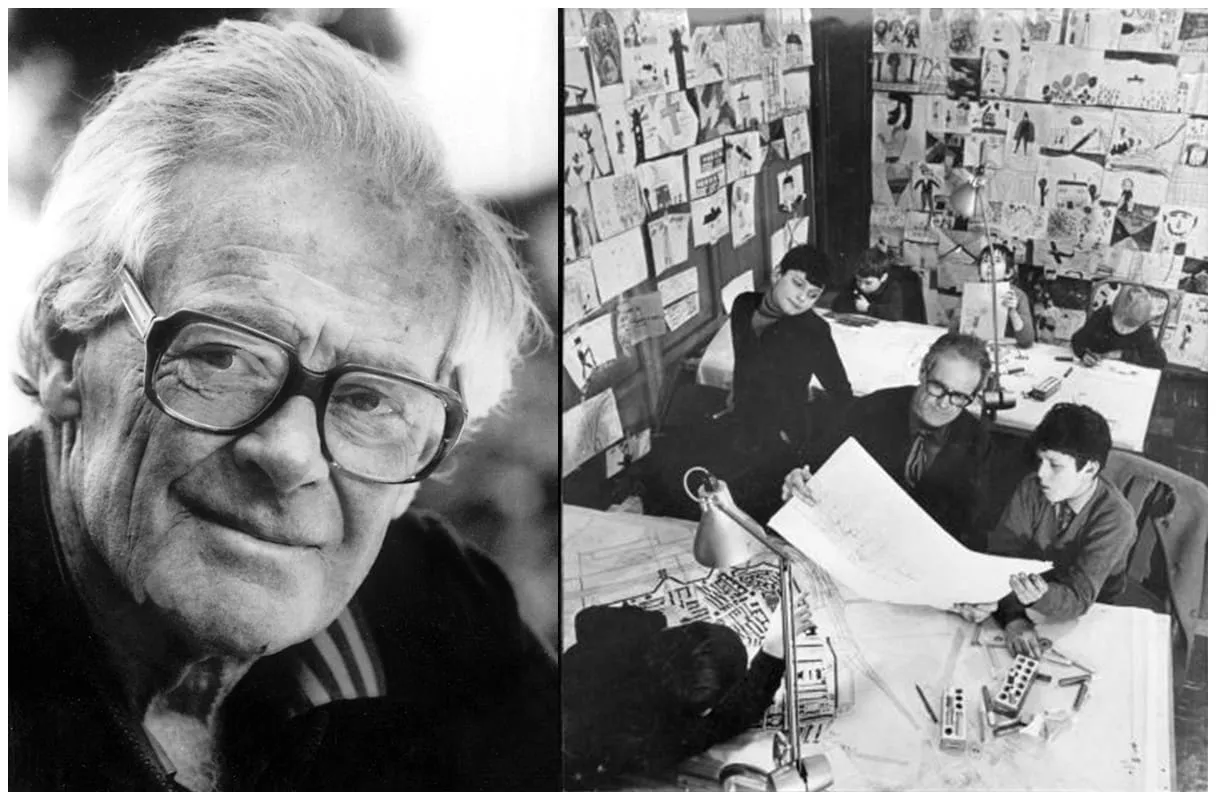
Ralph Erskine (1914–2005) was born in London and died in Drottningholm, Sweden
— a trajectory that tells much of his story. A British architect who settled in Scandinavia, Erskine spent six decades developing a practice rooted in climate responsiveness, community participation and the conviction that architecture exists primarily to serve the people who inhabit it.
From London to the Swedish Forest
Erskine trained at the Regent Street Polytechnic in London and subsequently at the Royal Academy of Arts in Stockholm, arriving in Sweden in 1939. His reasons for staying were partly circumstantial — the outbreak of World War II made return impractical — and partly temperamental. Sweden’s social democratic context and its architecture scene aligned with the values Erskine had developed through his Quaker upbringing: service, community, anti-hierarchy.
Life in a Box — The Lissma Experiment
Erskine’s early years in Sweden were spent in remarkable material circumstances. He and his wife Ruth built a simple cabin — the ‘Box’ — in the forest outside Stockholm, living without running water or electricity for several years. This was not asceticism for its own sake but a practical investigation into thermal performance, minimal construction and self-sufficiency. The experience directly informed his subsequent architectural thinking about climate, enclosure and the relationship between building and landscape.
Sandviken — A Town for Workers
Erskine’s commission for the Sandviken steelworks community in central Sweden became his first major realisation. Working through the 1950s and into the 1960s, he designed housing, community buildings and infrastructure for a factory town — work that demonstrated his ability to operate at the scale of urban planning while maintaining attention to the individual dwelling. His designs for Sandviken established principles he would develop throughout his career: orientation toward the sun, protection from prevailing winds, and collective spaces that encourage informal contact.
Arctic Architecture — Building at the Edge
No aspect of Erskine’s work has been more influential than his thinking on Arctic and sub-Arctic housing. Commissioned to design housing in Kiruna and other northern Swedish towns, Erskine developed a set of principles for building in extreme cold that moved well beyond standard technical responses. His Arctic settlements typically feature a dense, continuous built perimeter on the north and west sides — acting as a windbreak — with housing oriented south and east to maximise solar gain. Streets and public spaces are concentrated within this sheltered zone. The approach was not merely technical but social: the compact form concentrated community life rather than dispersing it across a hostile landscape.
Byker Wall — Community Architecture in Newcastle
Erskine’s most internationally celebrated project is the Byker Wall housing development in Newcastle upon Tyne, designed from 1969 and built through the 1970s. Commissioned to rehouse an existing working-class community, Erskine established a site office within the neighbourhood, employed local residents, and conducted an ongoing consultation with existing tenants throughout the design and construction process. The result — a long, sinuous block (the ‘Wall’) protecting lower-density housing to its south — was formally inventive and socially ambitious. Byker was awarded Grade I listed status in 2007, among the first post-war housing developments to receive that designation in England.
Later Work and Recognition
Erskine continued working into his eighties, completing projects including the Ark office building in Hammersmith, London (1992) and continued work in Sweden and internationally. He received the Royal Gold Medal from the Royal Institute of British Architects in 1987 and the Wolf Prize in Arts in 1984. He remained based outside Stockholm until his death in 2005, and the practice he founded — Erskine Nicolin Arkitekter — continues in Sweden.