
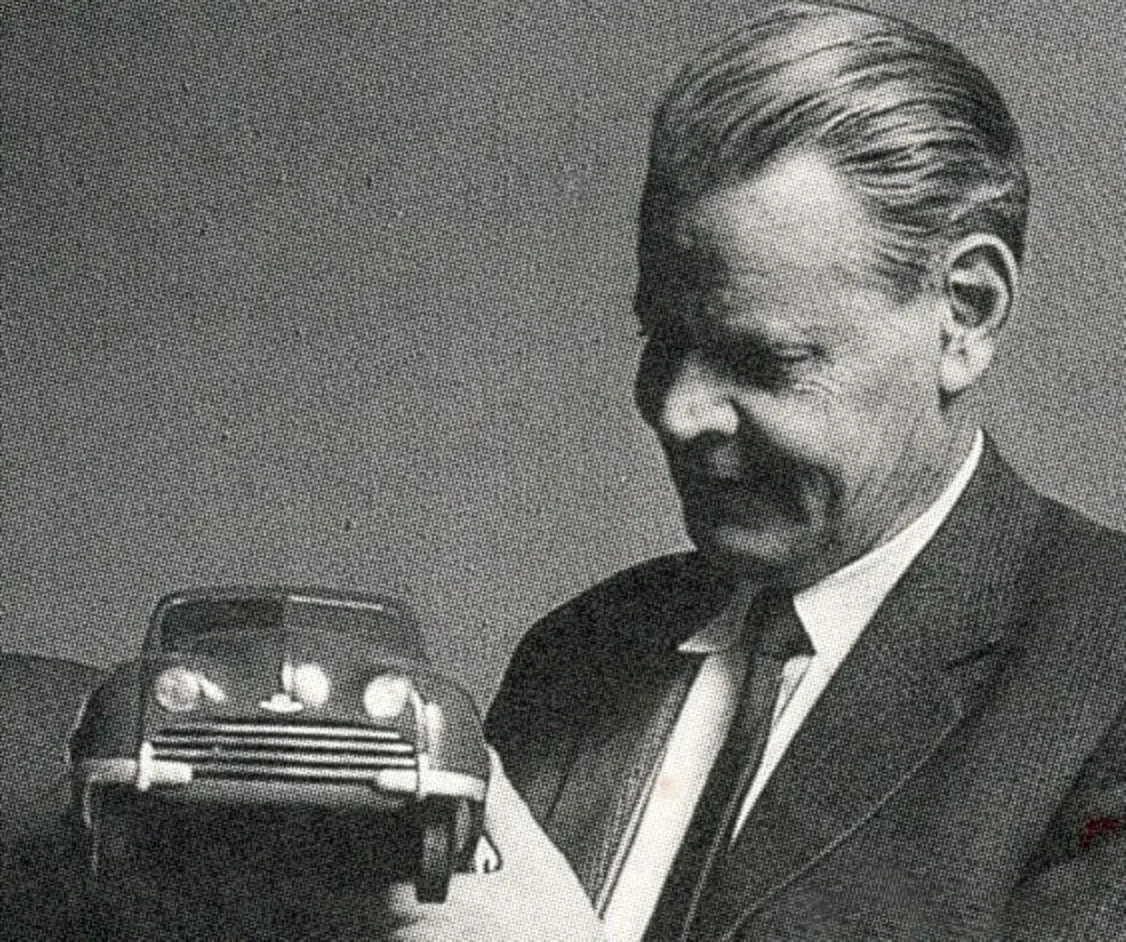
Sixten Sason: The Swedish Designer Behind Saab, Hasselblad and Electrolux
Sixten Sason (1912–1967) was Sweden’s most versatile industrial designer of the postwar era — a man who shaped automobiles, cameras, vacuum cleaners and motorcycles with equal authority.
Born Karl-Erik Sixten Andersson in Skövde, he trained as a fine artist in Paris before gravitating toward engineering and industrial design, eventually taking the surname Sason from the Spanish word for spice.
From Aircraft to Automobiles
Sason joined Saab during the Second World War, working as a designer of military aircraft including the Saab 17 and Saab 18. By the end of the war he was considered Sweden’s leading industrial designer. In 1946 he was asked to join Project 92 — the development programme for Saab’s first automobile — alongside engineer Gunnar Ljungström. The result was the Saab 92, which entered production in 1949. Its aerodynamic, aircraft-influenced body set the tone for everything that followed. Sason went on to design the 93, 95, 96 and 99, as well as the body and chassis of the first Saab Sonett, introduced in 1956. The Saab 99, which entered production in 1967 — the year of his death — carried design elements that remained visible in Saab’s output into the 1990s.
Hasselblad and the 1600F
In parallel with his Saab work, Sason designed what would become one of the most significant cameras of the 20th century. In 1948–49, Hasselblad commissioned him to design their first civilian camera model — a medium-format single-lens reflex that entered production as the Hasselblad 1600F. It was the camera system that Hasselblad developed further into the one used by the Apollo 11 crew in 1969.
Electrolux, Husqvarna and Monark
Sason’s client list extended across Swedish industry. For Electrolux he designed a series of vacuum cleaners, most notably the Z 70 in 1957 — a machine notable for its sculptural, streamlined form. For Husqvarna he designed motorcycles including the Silverpilen, a lightweight 175cc model sold between 1955 and the mid-1960s. For Monark he designed the Monarscoot scooter. Each commission demonstrated the same discipline: functional clarity expressed through aerodynamic, visually resolved form.
Legacy
Sason died in April 1967 at the age of 55, six months before the Saab 99 he had designed went on sale. He was succeeded at Saab by his colleague and former student Björn Envall. His design office, Sixten Sason AB — one of the first independent industrial design consultancies in Sweden, modelled on American practice — had demonstrated that a single designer working across automotive, photographic and consumer product industries could establish a coherent and influential design language. That breadth of practice remains unusual in Scandinavian design history.