

Søren Sögreni (1955–2024) — The Danish Bicycle Designer Who Made Cycling an Art Form
Søren Gregers Nielsen, known to the world as Sögreni, passed away in 2024 at the age of 68. Born in Copenhagen on 1 October 1955, he spent more than four decades turning the bicycle into a design object — handcrafted, uncompromising, and deeply personal.
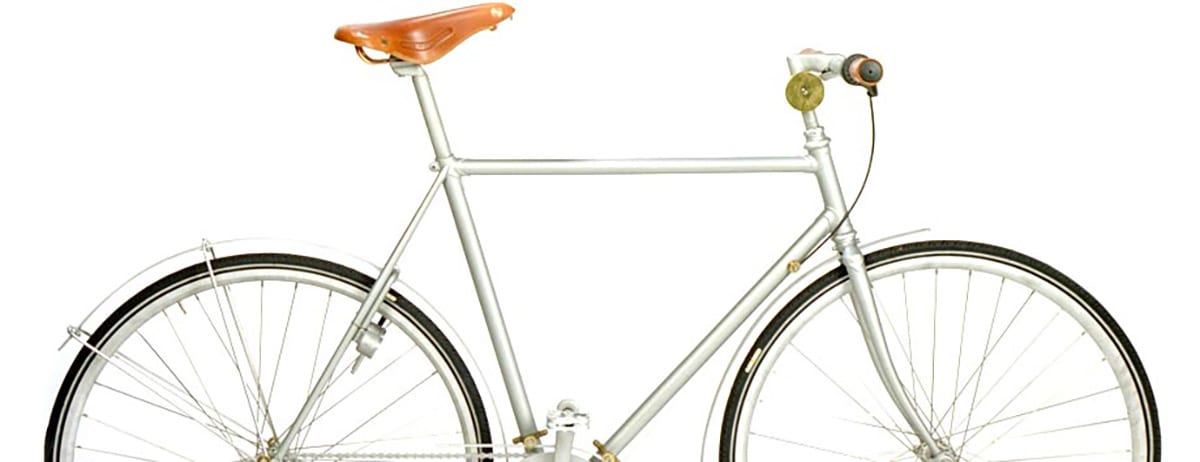
In 1980, Nielsen opened his bicycle workshop in Sankt Peders Stræde in central Copenhagen. His motivation was simple: he found the quality of commercially available bicycles miserable, and decided to do something about it. From that small, dimly lit shop — packed with frames, spare parts, and curiosities collected from travels across the Americas — he built one of the most distinctive design practices in Danish design history.
He was not a designer trained in the traditional sense. He was a craftsman with an obsessive eye for detail and a genuine disregard for compromise.
Nielsen began producing his own bicycle frames in 1985. In 1990, he expanded into accessories, introducing aluminium mudguards, wooden mudguards — he has been credited as the first designer in modern European bicycle production to introduce wooden fenders — and leather grips. Each addition to the range followed the same logic: identify what was wrong with existing solutions and solve it with the simplest possible means.
The Sögreni bell, introduced in 1995, became his most recognized product. Flat rather than dome-shaped, it was inspired by the profile of his own mudguards. Lamps followed in 1999 — compact, easy to attach and remove, with a twist mechanism that prevented accidental activation in a bag or pocket. Trouser clips completed the range in 2000. All accessories were produced by hand, in limited numbers, bearing the Sögreni trademark.
In the mid-1990s, Louisiana Museum of Modern Art in Humlebæk invited Nielsen to design a bicycle for the museum. The result was the Sögreni Classic — also called the Louisiana Bike — stripped of everything non-essential: no gears, no extras, just frame, handlebar, two wheels and a saddle. A Sögreni Classic is held in the permanent collection of the 21st Century Museum of Contemporary Art in Kanazawa, Japan. Museums across Europe and North America stock Sögreni accessories in their museum shops.
In 2002, Nielsen was nominated as Danish Designer of the Year. His work was frequently selected by the Danish Ministry of Culture for presentations of Danish design abroad. International publications including Wallpaper and Condé Nast Traveller covered his work regularly. He was described by cycling commentators as “the grandfather of modern Danish bicycle design.”
Every Sögreni bicycle was built to order, with a delivery time of eight to sixteen weeks. Each was delivered with a certificate signed by Nielsen himself and a 25-year frame warranty — backed by an anti-corrosion treatment applied to components that he maintained was unique to his workshop.
His products were available in Denmark, Sweden, England, Ireland, France and Germany.
Søren Gregers Nielsen leaves behind a workshop, a body of work held in museums on multiple continents, and a philosophy of bicycle design that remains as clear today as it was when he first opened his doors in Copenhagen over forty years ago.