
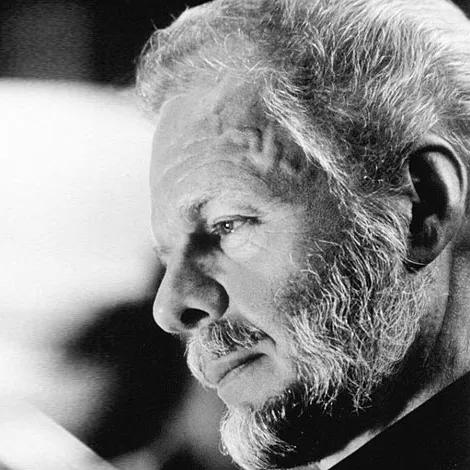
Timo Sarpaneva and the Poetry of Glass — How Light Became Form
Timo Sarpaneva (1926–2006) was among the most internationally recognised Finnish designers of the postwar era and the figure who most successfully positioned glass as a medium for artistic expression within industrial production. Over a career spanning five decades, working primarily with Iittala but also across ceramics, textiles, metal and exhibition design, Sarpaneva demonstrated that serial production and sculptural ambition were not incompatible. His work — particularly his glass sculptures and vessels — established Finland as a centre for glass art and helped define what became understood internationally as Scandinavian design.
Formation and Early Recognition
Sarpaneva was born in Helsinki in 1926 and studied graphic design at the Central School of Arts and Crafts (Taideteollinen korkeakoulu), graduating in 1948. His training was in two-dimensional composition — typography, layout, visual communication — rather than in three-dimensional form or material craft. This background proved significant: Sarpaneva approached glass design through visual effect and spatial composition rather than through inherited glassblowing traditions. He was interested in how glass behaved optically — how it refracted light, created internal reflections, transmitted and absorbed colour — and he designed accordingly.
His breakthrough came in the early 1950s when he began working with Iittala glassworks. Unlike Tapio Wirkkala, whose collaboration with Iittala emphasised organic form and natural reference, Sarpaneva pursued abstraction and pure visual phenomena. His designs from this period — including the i-line series (1956) and various sculptural pieces — demonstrate an engagement with glass as a material of light and space. He described glass as “the material of space, best suited to be given to light” — a formulation that clarifies his approach. Glass was not valuable to Sarpaneva for its decorative potential or its capacity to hold liquids, but for its ability to make light visible, to give optical phenomena material form.
Milan Triennales and International Position
Sarpaneva’s reputation was established through the Milan Triennale exhibitions of the 1950s and 1960s, where Finnish design achieved unprecedented international recognition. He won multiple Grand Prix awards — the Triennale’s highest honour — positioning him alongside Wirkkala, Kaj Franck and other Finnish designers as cultural ambassadors for a nation seeking to establish its postwar identity. The Triennale context was significant: these were not trade fairs but juried exhibitions that treated industrial design as a form of applied art worthy of critical attention. Success at Milan meant validation from an international design community and access to markets beyond Scandinavia.
Sarpaneva’s Triennale exhibits combined production pieces — vessels and tableware that could be manufactured serially — with unique sculptural works that demonstrated technical and artistic possibilities without concern for commercial viability. This dual approach allowed him to maintain credibility as both artist and industrial designer, operating at the intersection of fine art and mass production. The strategy proved commercially astute: his sculptural reputation enhanced the perceived value of his production designs, while the existence of affordable production pieces made his work accessible to a broader public.
Glass as Sculptural Medium
Sarpaneva’s glass sculptures occupy a territory between vessel and pure form. Many retain functional referents — they suggest bowls, vases, containers — but their proportions, surfaces and internal structures push them toward autonomous sculptural objects. His Claritas series, for instance, comprises heavy glass forms with deeply cut facets that fragment and redirect light. The pieces function as vessels only nominally; their purpose is optical drama. Similarly, his Lansetti (Lancet) series uses elongated vertical forms with internal air channels to create linear light effects — the glass becomes a medium for displaying light’s behaviour rather than an end in itself.
This sculptural approach required close collaboration with Iittala’s master glassblowers and finishers. Sarpaneva’s designs often demanded techniques at the edge of what was achievable in series production: heavy castings that required extended annealing periods, complex internal structures formed through multiple blowing stages, surfaces that needed extensive cold-working after initial forming. The partnership between designer and maker was essential — Sarpaneva proposed effects and forms, craftspeople developed methods to realise them, and the results fed back into subsequent designs.
Range Across Materials
While glass remained Sarpaneva’s primary medium, his practice extended across materials and scales. He designed cast-iron cookware for Rosenlew — pots that translated his sculptural sensibility into industrial casting, creating functional objects with formal authority. His textile designs, produced for various Finnish manufacturers, demonstrate the same attention to optical effect visible in his glass: bold geometric patterns, high contrast, concern with how light falls across folded or draped fabric. His exhibition designs — including installations for Finnish participation at world expositions — showed an architect’s sense of spatial sequence and material juxtaposition.
This versatility reflected a generation of Finnish designers who saw no fundamental distinction between designing a glass sculpture, a textile pattern, a piece of furniture or an exhibition pavilion. The underlying concerns — form, material, light, spatial experience — remained consistent regardless of scale or medium. Sarpaneva moved between projects fluidly, applying similar formal thinking to whatever problem presented itself.
Light and Material Philosophy
Central to Sarpaneva’s work was an interest in making visible phenomena that are ordinarily experienced but not consciously observed. He described his ambition as showing “light as if seen from beneath the ice that covers the sea, or in the living foliage of the forest” — not representing these scenes but capturing the quality of light they produce. This required understanding how light behaves in different materials and conditions: the diffusion through ice, the filtering through leaves, the reflection from water surfaces. His glass pieces attempted to recreate these optical conditions through controlled manipulation of transparency, refraction and internal structure.
This approach distinguished Sarpaneva from designers who treated glass primarily as a transparent material to be shaped. For Sarpaneva, glass was valuable precisely because it was neither fully transparent nor fully opaque — it existed in a state of partial revelation, allowing light through while transforming it. His designs exploited this ambiguity, creating objects that changed appearance depending on lighting conditions, viewing angle and context. A Sarpaneva vessel in direct sunlight produces different optical effects than the same piece in diffuse interior light — a quality he considered essential rather than incidental.
Recognition and Legacy
Sarpaneva’s honours include Honorary Royal Designer for Industry from the Royal Society of Arts, London (1963), Honorary Doctor from the Royal College of Art, London (1967), and Professor honoris causa from the Academy of Design, Mexico City (1985). These titles reflect international recognition that extended beyond the design community to academic and cultural institutions. His work entered museum collections internationally and was subject to numerous retrospective exhibitions, including a major US tour in 1994–95 covering New York, Chicago, Los Angeles and Washington.
He died in Helsinki in 2006, leaving a body of work that demonstrated glass design could operate as fine art while remaining connected to industrial production. His influence on subsequent Finnish glass artists and designers is substantial — the generation that followed absorbed his lesson that material limits are creative opportunities rather than constraints. Sarpaneva proved that a designer could maintain artistic ambition while working with manufacturers, that serial production could accommodate sculptural thinking, and that everyday objects could embody poetry without ceasing to function.
Bird bottle & bowl tribute to the visionary designer Timo Sarpaneva – Iittala
Bird bottle and bowl pay tribute to visionary designer Timo Sarpaneva (1926-2006), one of Finland’s …

Timo Sarpaneva exhibition 2018 @ Designmuseum, Helsinki
23 March –23 September 2018 Timo Sarpaneva (1926–2006) is best known for his designs of …

Timo Sarpaneva – Finnish Glass Designer and Master of Light
Timo Sarpaneva and the Poetry of Glass — How Light Became Form Timo Sarpaneva (1926–2006) …