

Ilmari Tapiovaara – Social Vision and Industrial Craft in Postwar Finnish Design
Ilmari Tapiovaara (1914–1999) was a Finnish furniture designer whose career bridged European modernism and the particular conditions of postwar Finland — a nation rebuilding from conflict, industrialising rapidly, and seeking to provide affordable, well-designed domestic environments for a broad population. His furniture, particularly his bentwood chairs, represents a sustained attempt to reconcile modernist formal principles with industrial production methods and social purpose. Where many designers of his generation pursued individual expression or luxury markets, Tapiovaara committed to democratic design — furniture that could be manufactured economically, transported efficiently, and accessed by ordinary households.
Formation and Le Corbusier’s Influence
Tapiovaara was born in Tampere in 1914 and studied interior architecture at the Central School of Industrial Design (Taideteollinen oppilaitos) in Helsinki. His education coincided with the spread of modernist ideas across Scandinavia — functionalism, rational planning, the social responsibility of design. Following graduation, he worked briefly in Le Corbusier’s Paris studio, an experience that proved formative. Le Corbusier’s approach — architecture and furniture as components of a total living environment, industrial materials embraced rather than disguised, social housing as a proper subject for design attention — aligned with Tapiovaara’s emerging interests and informed his subsequent practice.
Returning to Finland in the late 1930s, Tapiovaara entered a design culture shaped by competing impulses: the legacy of Finnish craft traditions, the influence of Swedish functionalism, and the practical demands of a small industrial economy with limited resources. His work would navigate these tensions, seeking forms that acknowledged craft without sentimentalising it, that pursued industrial efficiency without sacrificing quality, and that served social needs without didacticism.
Keravan Puuteollisuus and Industrial Practice
Between 1945 and 1951, Tapiovaara served as artistic director at Keravan Puuteollisuus, a furniture manufacturer near Helsinki. This position gave him direct engagement with production realities — wood sourcing, factory capacity, worker skills, distribution logistics, pricing. Unlike designers who submitted drawings to manufacturers and moved on, Tapiovaara worked inside the production process, developing designs that responded to what the factory could realistically achieve and what the market could afford.
The Domus chair, designed in 1946, emerged from this context. Constructed from bent birch plywood and solid birch, the chair uses relatively simple forming techniques — steam-bending for the legs, moulded plywood for the seat and back — to create a lightweight, stackable, durable design. The chair was marketed in the United States as the “Finnchair” and achieved substantial commercial success. What distinguished the Domus from countless other postwar plywood chairs was its proportions — the relationship between seat height, back angle and armrest position — and its structural clarity. Every component is legible; the chair’s assembly is evident. This transparency was deliberate: Tapiovaara believed users should understand how their furniture was made and be able to repair it themselves.
Teaching and Pedagogical Influence
Concurrent with his industrial practice, Tapiovaara taught interior design at Helsinki’s Technical University and at the School of Industrial Arts (which became the University of Industrial Arts). His teaching extended over several decades and shaped multiple generations of Finnish designers. His pedagogical approach emphasised material understanding, structural logic, and social responsibility. Students learned to design not for exhibition or luxury markets but for actual production and use. They were expected to understand joinery, to test prototypes, to consider manufacturing costs and distribution challenges. This practical orientation reflected Tapiovaara’s conviction that design was a service rather than self-expression — a position that distinguished him from contemporaries who prioritised artistic ambition over social utility.
International Development Work
From the 1950s onward, Tapiovaara undertook projects in developing economies — Mauritius, Hong Kong, Yugoslavia — where he worked on furniture design adapted to local materials, production capabilities and climate. This work extended his democratic design principles into contexts where industrial infrastructure was limited and traditional craft methods remained dominant. His approach in these settings was to identify local materials that could substitute for European standards, to develop simplified production methods that local workshops could manage, and to design furniture appropriate to tropical climates and different domestic patterns.
This international practice positioned Tapiovaara as a design consultant concerned with technology transfer and capacity building rather than simply exporting Finnish design. The work remains relatively undocumented compared to his domestic practice but represents a significant aspect of his career — an attempt to apply modernist design methods to non-European contexts without imposing inappropriate formal solutions.
Bentwood Furniture and Material Exploration
Tapiovaara’s furniture output centred on bent and laminated wood — a material choice that reflected Finnish forestry resources, existing industrial capabilities, and his interest in lightweight, demountable structures. His bentwood chairs — including the Domus, the Mademoiselle (1956), and later designs — explore variations in bending radius, cross-sectional profile and joinery methods. The work shows sustained attention to how wood behaves under steam and pressure, how grain direction affects strength, and how bent components can be joined to create stable structures without excessive hardware.
This material focus distinguished Tapiovaara from contemporaries like Alvar Aalto, who worked with laminated wood in more sculptural ways, or from Danish designers who emphasised solid wood joinery. Tapiovaara’s approach was engineering-oriented: bends were sized for structural efficiency, thicknesses were calibrated to minimise material waste, forms were restrained to what bending techniques could reliably produce. The aesthetic that resulted — clean lines, visible structure, minimal ornament — arose from manufacturing logic rather than from imposed style.
Public Interiors and Institutional Commissions
Beyond individual furniture pieces, Tapiovaara designed complete interior environments for public buildings, educational institutions, hotels and civic facilities across Finland. These projects required coordinating furniture, lighting, textiles, colour schemes and spatial layouts — work that demonstrated his training as an interior architect. His institutional interiors from the 1950s and 1960s show an approach to public space that prioritised durability, ease of maintenance, and clear functional organisation over decorative effect. Materials were selected for longevity; furniture was specified for stackability and rearrangement; finishes were chosen for cleanability. This practical orientation reflected both economic constraints and social democratic principles — public buildings should serve their users efficiently without unnecessary luxury.
Legacy and Recognition
Tapiovaara received Finland’s Pro Finlandia Medal in 1959, was made an Honorary Royal Designer for Industry in Britain in 1969, and was awarded the Knight First Class of the Order of the White Rose of Finland. In 2014, Finland issued commemorative coins featuring his designs, acknowledging his contribution to Finnish design culture. His furniture remains in production through various European manufacturers, and vintage examples — particularly early Domus chairs — are collected internationally.
His influence on subsequent Finnish furniture design is substantial but operates through method rather than formal quotation. Few contemporary designers replicate Tapiovaara’s specific aesthetic, but many have absorbed his approach: attention to production realities, commitment to affordability and accessibility, willingness to work within industrial constraints rather than against them. These principles continue to distinguish Finnish furniture design from more artisanal or luxury-oriented production elsewhere, and position Tapiovaara as a foundational figure whose work demonstrated that social purpose and design quality were compatible rather than contradictory aims.
More design by Ilmari Tapiovaara:
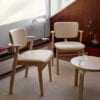
Domus Chair by Ilmari Tapiovaara 80 Years — New Editions from Artek
80 Years of Ilmari Tapiovaara’s Classic Artek is marking eighty years of Ilmari Tapiovaara’s Domus …

Edsbyn reintroducing the long-awaited Fanett in the 55T model – An icon relaunched
Fanett is a chair that has earned its place in Nordic furniture history, offering unique …

Travel as a tool @ Vandalorum
27 March – 19 September is a joint Nordic exhibition that considers the significance of …

The quest for a universal wooden chair – Artek meets Pekka Korvenmaa
Artek meets Pekka Korvenmaa to discuss the inventiveness of Ilmari Tapiovaara and the designer’s …
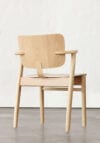
Domus Chair design Ilmari Tapiovaara by Artek
Tapiovaara’s Domus Chair: The Stackable Seat That Conquered the World Designed in 1946 for the …
The thoughts behind Artek’s stand designed by Shideh Shaygan
Shideh Shaygan: – For Artek’s stand at the Stockholm Furniture Fair 2020 I wanted to …
Artek and BLESS create BLESS N°60
Artek and BLESS create BLESS N°60 Lobby Conquerors for the Chicago Architecture Biennial Artek and …

Artek in Residence at PLY
Artek and the Hamburg interior studio PLY have joined forces to create the new retail …

Domus Chairs design Ilmari Tapiovaara 1946 – Artek
Domus Chair & Domus Lounge Chair design Ilmari Tapiovaara, 1946 “A chair is not just …

A documentary film about Ilmari Tapiovaara (1914–1999)
Ilmari Tapiovaara (1914–1999) was a Finnish designer and interior architect who created some of Scandinavia’s …
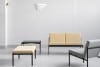
Kiki Collection by Ilmari Tapiovaara for Artek
The Kiki Collection design Ilmari Tapiovaara, 1960 Designing not for the few, but for the …

Ilmari Tapiovaara @ Designmuseum 2014
The year 2014 marks the centenary of the birth of designer Ilmari Tapiovaara (1914 – …

A documentary film about Ilmari Tapiovaara (1914-1999)
Ilmari Tapiovaara (1914–1999): The Humanist of Design Ilmari Tapiovaara was one of the greatest interior …

Ilmari Tapiovaara – Finnish Furniture Designer and Social Modernist
Ilmari Tapiovaara – Social Vision and Industrial Craft in Postwar Finnish Design Ilmari Tapiovaara (1914–1999) …