
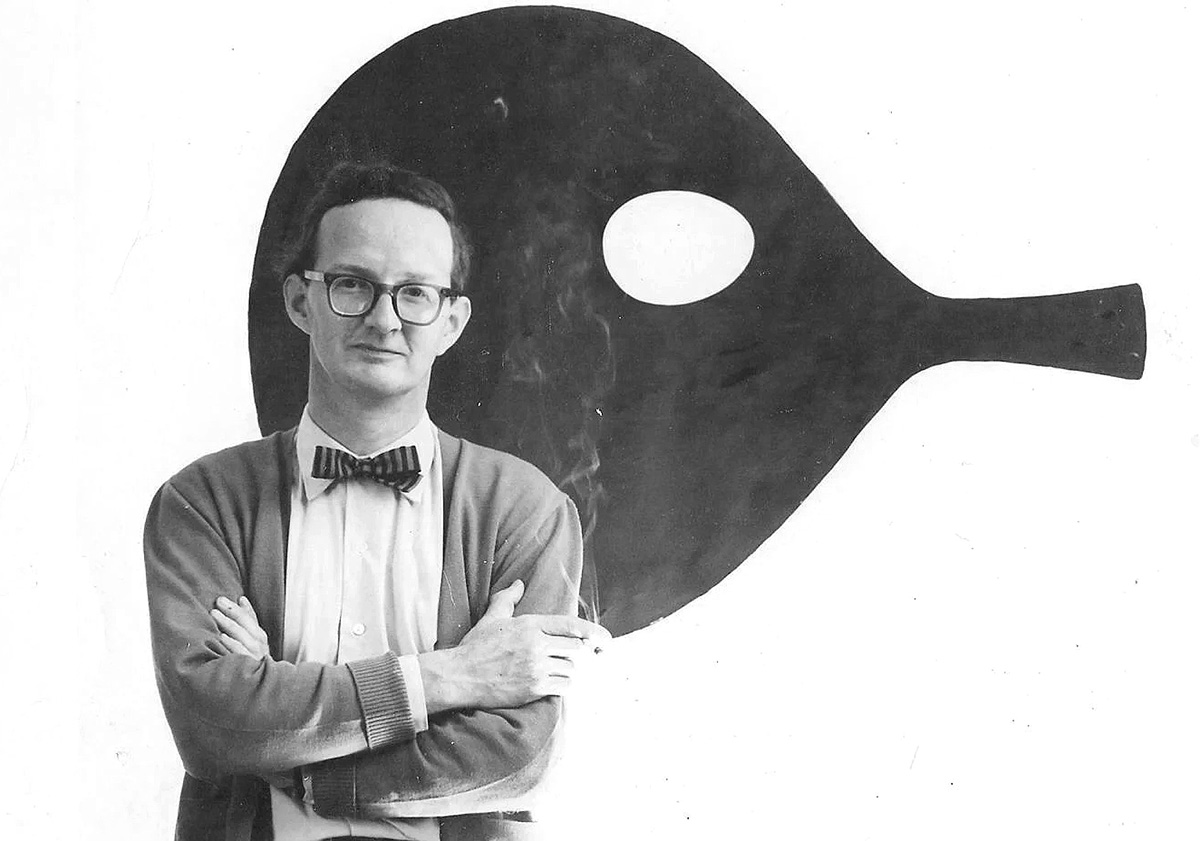
Stig Lindberg (1916–1982) was one of the defining Swedish designers of the postwar decades. For more than forty years he worked at the Gustavsberg porcelain factory outside Stockholm, where he created tableware such as Berså and Spisa Ribb that found its way into homes across Sweden. Ceramics was only the start: Lindberg also designed textiles, glass, plastics and televisions, and illustrated children’s books with a hand that is recognisable at a glance.
Background
Lindberg was born in Umeå in northern Sweden and studied painting at Konstfack in Stockholm. In June 1937, aged 20, he turned up at Gustavsberg looking for work – the same year the consumer cooperative KF took over the factory, a coincidence told in the Gustavsberg Porcelain Museum’s centenary exhibition. He trained under artistic director Wilhelm Kåge, and in 1942 the two set up G-studion, an experimental studio inside the factory where artists could work freely alongside the production lines. When Kåge stepped down in the late 1940s, Lindberg succeeded him as artistic director.
Gustavsberg and the folkhem
Under KF, Gustavsberg had a social mandate: good everyday objects at prices ordinary households could afford. Lindberg took the brief seriously, and his designs became part of how modern Sweden furnished itself – he is sometimes called the man who designed the folkhem. In the mid-1950s he left the factory to teach ceramics at Konstfack, while continuing to design for Gustavsberg, before returning as artistic director in the early 1970s. He stayed until 1980, then moved to Italy, where he died in 1982.
Key designs
Lindberg’s tableware ranges were sold through KF’s stores and bought by generations of Swedes. Among the best known:
- Berså (1960) – green leaves in a dense, rhythmic pattern; perhaps the most loved Swedish tableware decor of the century.
- Spisa Ribb (1955) – ovenproof stoneware with a restrained brown ribbed band, made to go from oven to table.
- Domino, Terma and Pungo (1953–55) – graphic decors and organic stoneware forms from his most productive decade.
- Hand-painted faience – the decors he showed at Gustavsberg’s Stockholm shop in 1942, which established his name.
Several of his patterns are in production again at Gustavsberg, and his designs continue to be reinterpreted. In one example, Note Design Studio adapted four Lindberg patterns for granite ceramic tiles for Bricmate.
Beyond ceramics
The factory also produced bathtubs and plastics, and Lindberg designed for both – the Termic thermos, the Fontana watering can and the Skotte money box among them. Through KF’s Luma company he designed a television set. From 1947 he created printed textiles for the department store NK, where Astrid Sampe brought him into the textile studio’s circle of designers. He also designed glass for Holmegaard, a deck of cards, enamel works and public commissions. His illustrations for Lennart Hellsing’s books about Krakel Spektakel are still read today.
Recognition
Lindberg won gold medals at the Milan Triennale in 1948 and 1957 and the Grand Prix in 1951 and 1954. He received the Gregor Paulsson Trophy in 1957 and the Prince Eugen Medal in 1968, and was given an honorary professorship by the Swedish government in 1970.
Exhibitions about his work return regularly. Millesgården showed some 400 objects in 2022, including a reconstruction of the home he shared with his wife Gunnel. His ceramics are part of a century of Scandinavian ceramics at Rian Designmuseum. For his 110th anniversary, the Porcelain Museum in Gustavsberg opened The joyful world of Stig Lindberg in June 2026. His successors at the factory include Lisa Larson, whom Lindberg brought to Gustavsberg in 1954.
By Editorial Team, ScandinavianDesign.com
More about Stig Lindberg/Gustavsberg:

The joyful world of Stig Lindberg
In the summer of 2026, the Porcelain Museum in Gustavsberg will open an exhibition about …
The magic of clay – Scandinavian ceramics through a hundred years @ Rian designmuseum
27 May – 27 August 2023 Modern ceramics contain a variety of expressions – from …
AfterGlow – New Nordic Porcelain @ Gustavsberg Porcelain Factory
AfterGlow – New Nordic Porcelain 4 June 2022 – 23 April 2023 Is there a …
Stig Lindberg @ Millesgården 2022
Millesgården open a major exhibition of the works of designer and illustrator Stig Lindberg (1916-1982) …

Lisa Larson @ Gustavsberg Porcelain Factory
On display June 23, 2020 – April 11, 2021. An exhibition about one of Sweden’s …
Wilhelm Kåge @ Gustavsberg Porcelain Museum
17 June–3 September 2017 At Gustavsberg Porcelain Museum, Värmdö. Dragonfish and urn, Farsta stoneware, plates …

Stig Lindberg 100 @ Gustavsberg Porcelain Museum
On a day in June 1937, the young Stig Lindberg arrived at the porcelain factory …

Gustavsbergs keramikpris 2013 går till Ann-Britt “Amba” Haglund
Villeroy & Boch Gustavsbergs keramikpris 2013 går till keramikern Ann-Britt Haglund Keramikern Ann-Britt Haglund får …

Mia E Göransson 5/6–19/9 2010 @ Gustavsbergs Konsthall
Mia E Göransson är en av landets mest uppskattade konsthantverkare. Hennes formspråk är starkt karaktäristisk, …