

Georg Jensen (1866–1935) trained as a sculptor before becoming Denmark’s best-known silversmith, and the company that carries his name has spent more than a century turning that same sculptural sensibility into silverware, jewellery and design objects.
Born to working-class parents outside Copenhagen, he apprenticed as a goldsmith at fourteen, studied sculpture at the Academy of Fine Arts, and struggled for years to make a living as an artist before turning fully to metalwork around 1900.
From sculpture to silver
Jensen apprenticed under master silversmith Mogens Ballin, and in 1904 opened his own small silversmithy on the second floor of a building on Bredgade in Copenhagen, financed with the help of a local backer. A 1904 exhibition of his independent work at the Museum of Decorative Art brought him to the attention of the designer Johan Rohde, whose long collaboration with Jensen shaped the company’s early Art Nouveau style. Recognition followed quickly: a gold medal at the 1910 Brussels Exhibition, a larger Copenhagen workshop in 1912, and the grand prize at the 1915 Panama-Pacific International Exposition in San Francisco, where William Randolph Hearst is said to have bought the entire exhibition outright.
Crisis, and a house built beyond its founder
Silver shortages during the First World War pushed the company into serious financial trouble by 1917. Jensen’s brother-in-law Thorolf Møller and the businessman Peder Anders Pedersen stepped in with new capital, and by 1924 Pedersen held the chairmanship — freeing Jensen to focus on design rather than the books until his death in 1935. That year, Pedersen and Møller financed a New York branch, run by the agent Frederik Lunning, whose Fifth Avenue store became the company’s showcase in America. In the 1930s Pedersen also launched PLATA, a separate line of silver-plated and steel goods.
A house of designers
From 1937, managing director Anders Hostrup-Pedersen recruited a generation of designers who took Georg Jensen well beyond its founder’s own hand: Sigvard Bernadotte, Henning Koppel, Søren Georg Jensen (the founder’s son), Magnus Stephensen, and Nanna Ditzel. Their work carried the company into major museum exhibitions — the Louvre in 1958, the Metropolitan Museum of Art in 1960, the Victoria and Albert Museum in 1962 — cementing Georg Jensen’s reputation as a design house rather than a workshop tied to one man’s style. Henning Koppel‘s fluid, organic silver forms and Sigvard Bernadotte‘s industrial design work remain some of the clearest examples of that shift, alongside Kay Bojesen, whose own workshop overlapped with Jensen’s circle of Copenhagen silversmiths in the same period.
Ownership since 1972
Royal Copenhagen acquired Georg Jensen in 1972, folding it into the Royal Scandinavia group alongside Orrefors Kosta Boda and Venini. The company has changed hands several times since: Axcel Capital Partners in 2001, Investcorp in 2012 for $140 million, and most recently the Finnish group Fiskars, which bought Georg Jensen from Investcorp in December 2023 for €155 million.
Georg Jensen today
Under Fiskars, Georg Jensen continues to operate as a standalone luxury house, still built around the same combination the founder established in 1904 — silverware and jewellery designed with a sculptor’s eye, made by hand in Copenhagen wherever the object calls for it.

More design from Georg Jensen

Georg Jensen introduces Fold, a new collection of home objects shaped by paper
Bends and curves in mirror-polished stainless steel give life to a series of vases and …

From Sculpture to Tableware: The Legacy of Henning Koppel’s Newest Oak Bowls
The Evolution of Mid-Century Mastery The name Henning Koppel is synonymous with the “Danish Modern” …

Panton Collection trays by Verner Panton for Georg Jensen
Panton Collection tray’s instantly recognisable crushed surface gives the design a strikingly individual look As …
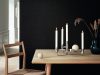
Tunes by Monica Förster – Georg Jensen
Tunes Tunes low candle holder Tunes high candle holder Tunes candelabra Tunes is a new …

Matrix by Monica Förster – Georg Jensen
Matrix Matrix vases Matrix bowls Matrix serving tray Matrix is a new Art Deco-inspired home …

Henning Koppel – Danish Silver Designer
Henning Koppel: Silver, Porcelain and Glass — A Multi-Decade Career Across Georg Jensen, Bing & …