
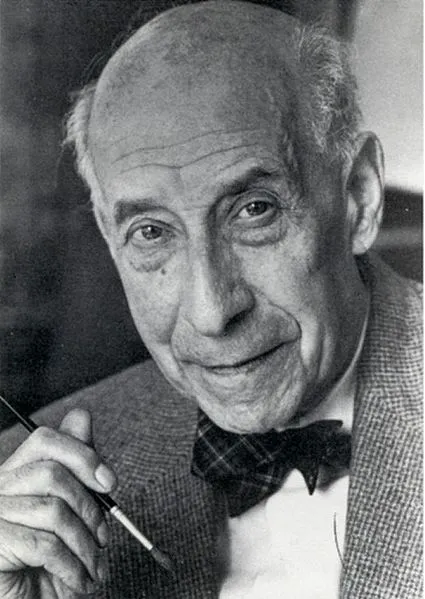
Josef Frank (1885–1967) arrived in Stockholm in 1934 as a refugee from National Socialism. What began as exile became one of the most consequential collaborations in Scandinavian design history — a partnership with Estrid Ericson at Svenskt Tenn that would define an entire aesthetic tradition.
From Vienna to Stockholm
Born in Baden bei Wien in 1885, Frank trained as an architect at the Vienna University of Technology and quickly became a central figure in the Wiener Werkbund movement. His early work was marked by a rejection of doctrinaire modernism — he famously argued against the notion that form must follow function at the expense of human joy and individuality. In his 1931 essay ‘Accidentism’, Frank articulated a philosophy that would guide his entire career: interiors should feel accumulated, lived-in, personal — not designed.
Exile and a New Beginning
The rise of National Socialism forced Frank, who was Jewish, to flee Austria. He settled in Stockholm, where he had already established a relationship with Estrid Ericson and Svenskt Tenn since 1932. The partnership gave Frank both financial security and creative freedom at a moment when his life had been upended. Stockholm became his permanent home for the rest of his life, interrupted only by years in New York during World War II.
The Textile Designs That Changed Everything
Frank designed over 160 textile patterns for Svenskt Tenn, and it is this body of work that remains his most recognisable legacy. Densely layered with botanical motifs — exotic plants, birds, flowers drawn from a global visual vocabulary rather than a strictly Nordic one — his fabrics deliberately contradicted the clean lines and restraint of mainstream Scandinavian modernism. Patterns such as Vegetable Tree, Heaven, and Anakreon remain in production today, generations after his death.
A Philosophy Against Reduction
Where the dominant Functionalist movement sought to strip the interior of ornament, Frank insisted on abundance. He believed that the home should be a refuge from rationalisation, not an extension of it. This position made him a contrarian figure within Scandinavian design discourse — and ultimately the reason his work has proved so enduring. His interiors mixed periods, geographies and materials without apology.
Architecture and Further Work
Beyond textiles, Frank continued designing furniture and working on architectural projects. His furniture for Svenskt Tenn — including the Chair 1000 series and various occasional tables — reflects the same anti-hierarchical approach: pieces meant to coexist rather than match. His architectural writings remained influential in design education in Sweden long after his death in Stockholm in 1967.
Legacy
Josef Frank occupies a singular position in Nordic design history — an outsider who became central, a European modernist who rejected modernism’s coldness, a refugee whose adopted country gave his work its fullest expression. Svenskt Tenn continues to produce his textiles and furniture, ensuring that Frank’s garden-filled vision of the domestic interior remains accessible to new generations.
More design from Josef Frank:

Josef Frank: 140 Years of Timeless Design Shaping Modern Living
Design History Milestone: Josef Frank’s 140th Birth Anniversary Josef Frank, (1885 – 1967) a prominent …

Mignon lamp Svenskt Tenn’s 100th anniversary in 2024
New arrivals by Josef Frank Among the autumn arrivals at Svenskt Tenn are these outstanding …

New Dawn exhibition @ Svenskt Tenn 2022
A number of new products from five different designers will be launched in this year’s …

Aurora Wallpaper design by Josef Frank, 1947 – Svenskt Tenn
Wallpaper Aurora With their pink, blue and violet tones, reminiscent of a shimmering morning light, …

Travel as a tool @ Vandalorum
27 March – 19 September is a joint Nordic exhibition that considers the significance of …

Svenskt Tenn / Chairs by Josef Frank exhibition
Shown at Strandvägen 5 08.02.2021 – 14.03.2021 Josef Frank had his own philosophy regarding …

Josef Frank’s Flora @ Sofiero Palace
Exhibiting at Sofiero Palace 29.04.2020 – 20.09.2020 “Will Frank’s flowers ever wilt? It doesn’t seem …

Swedish Tenn turns 95 years old to day!
Svenskt Tenn was founded in 1924 by Estrid Ericson, who recruited Josef Frank to the …

Josef Frank – Against Design @ ArkDes
March 10, 2017 – August 27, 2017 The exhibition Josef Frank – Against Design is …

Josef Frank @ Millesgården 2016
In Millesgården’s major summer exhibition, the designer and artist Josef Frank (1885-1967) is placed in an …

Josef Frank — Designer and Textile Pioneer at Svenskt Tenn
Josef Frank (1885–1967) arrived in Stockholm in 1934 as a refugee from National Socialism. What …