
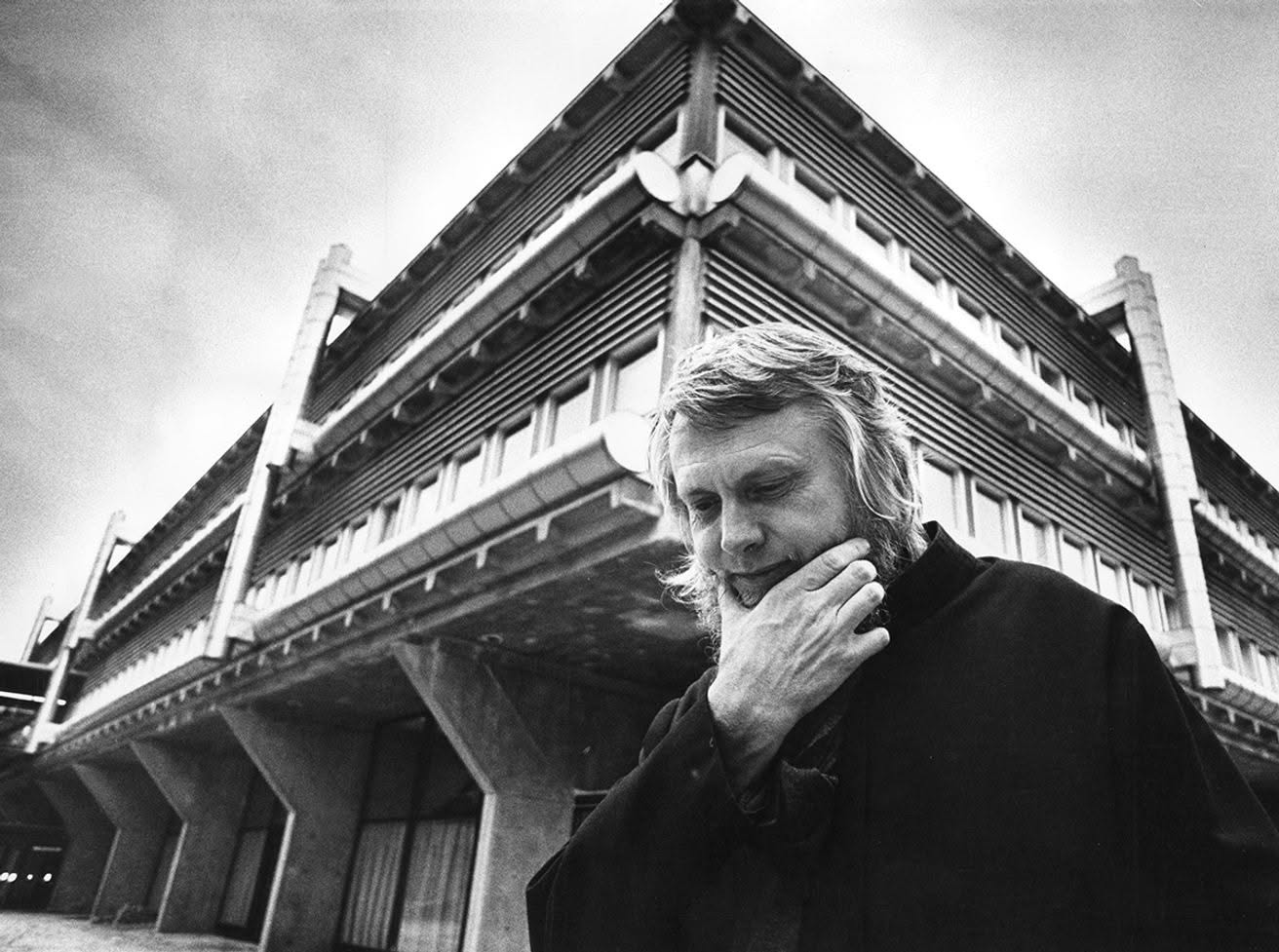
Bernt Nyberg (1927–1978) was a Swedish architect based in Lund, whose small, uncompromising body of work has made him something of a cult figure among architects — better known today for how few of his buildings survive than for how many he built.
From Ockelbo to Lund
Born in 1927 in Ockelbo, Nyberg studied architecture at KTH in Stockholm before moving to Lund to work under the architect Klas Anshelm. He set up his own office with Karl Koistinen in 1958 and later practised independently, working almost entirely within the Lund and Skåne region for the rest of his career.
Independent practice and Brutalist works
Nyberg’s buildings — among them the Klockarebacken funeral chapel in Lund — are usually described as Brutalist, built with a consistency of detailing across every scale of a project and a deliberately archaic, weathered quality, as though the buildings were older and more permanent than they actually were. He died in 1978, still in his architectural prime, having built relatively little and published even less. Much of what he did build has since been demolished or substantially altered, and preserving his surviving work has become its own small field of study — the subject of exhibitions at Skissernas Museum in Lund and the Royal Academy of Fine Arts in Copenhagen.
Documenting Sigurd Lewerentz
Nyberg was close to the older architect Sigurd Lewerentz, and took it upon himself to record him — filming and recording interviews that stand today as some of the only first-hand documentation of Lewerentz’s own account of his design thinking. In doing so, Nyberg became, in effect, Lewerentz’s first biographer, long before either architect received the wider recognition both now have.
The studio table
Nyberg designed a low worktable for his own studio in Lund — black-painted steel and birch plywood with solid birch edging, set on small rubber castors so it could be wheeled out of the way and stored under a drawing board between uses. The studio table is now produced by Tallum, the Swedish manufacturer that also produces furniture by Gunnar Asplund and Sigurd Lewerentz — working from Nyberg’s descendants to update details, such as the castors, that are no longer manufactured to the original specification, while keeping the plywood core and steel frame true to the original design.
A fragile legacy
Nyberg’s near-anonymity during his lifetime, combined with the loss of much of his built work, has made him a case study in how easily significant modern architecture can disappear before it is properly recognised. What remains — a handful of buildings, some film footage of Lewerentz, and a single piece of furniture now back in production — is a small archive for a career that ended far too early.