
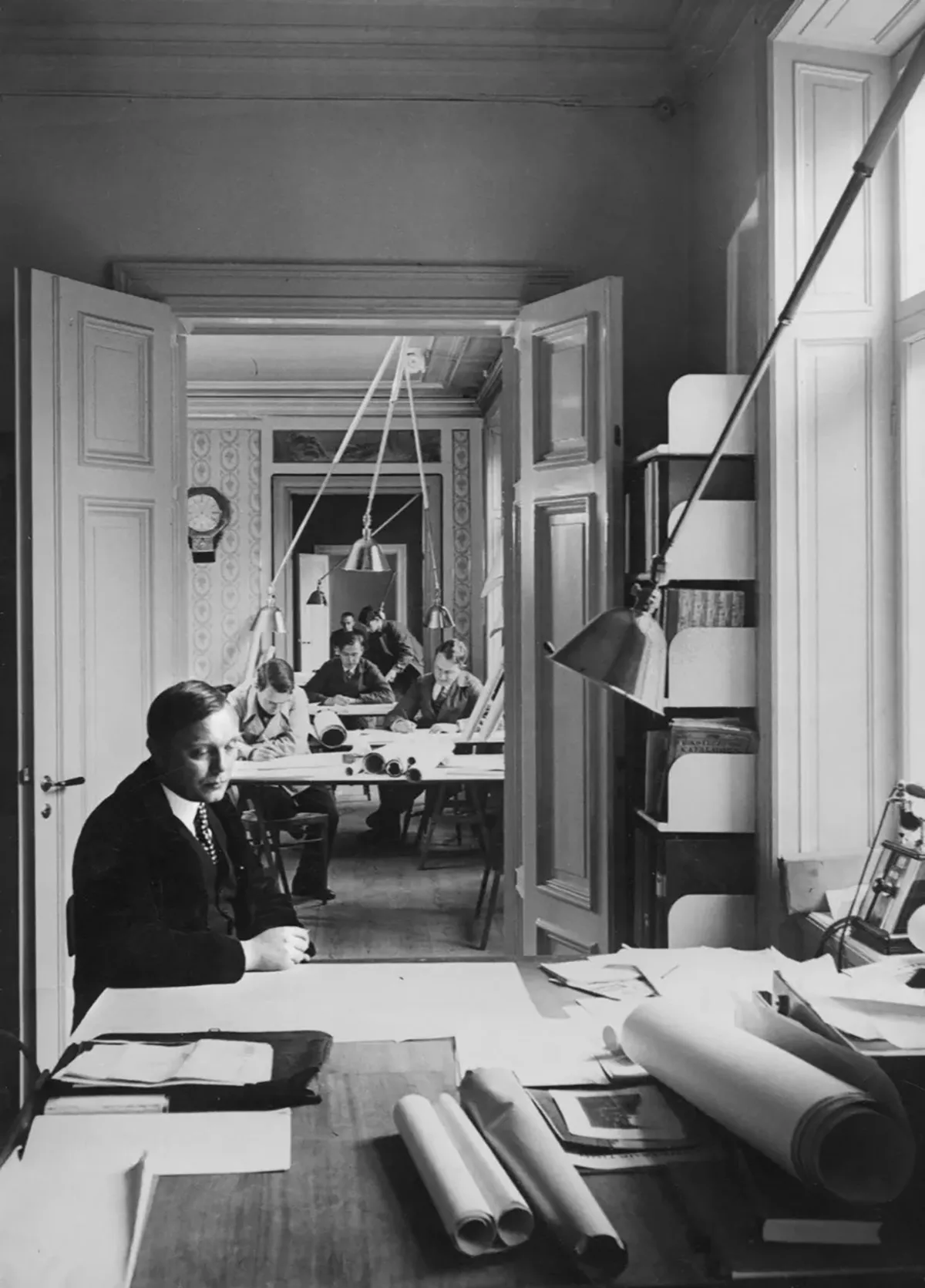
From Woodland Crematorium to Stockholm City Library – Gunnar Asplund’s Architecture That Changed Sweden
The Architect Who Gave Sweden Its Modern Identity
Every profession has its giants. In Scandinavian architecture, Gunnar Asplund (1885-1940) stands tallest. Not because he built the most buildings, but because he built the right buildings at precisely the right moment in history.
Born in Stockholm in 1885, Asplund entered the Royal Institute of Technology’s School of Architecture in 1905. Nine years later, in 1914, he embarked on a decisive journey to Italy that would fundamentally alter his architectural philosophy. Upon his return in 1915, he and Sigurd Lewerentz won first prize in the International Architecture Competition for Stockholm’s Woodland Cemetery—a project that would occupy portions of his career until 1940.
The Woodland Chapel: Where Tradition Meets Innovation
Asplund’s Woodland Chapel (1920) demonstrated his remarkable ability to synthesize vernacular Swedish imagery with classical motifs. This was no simple pastiche. Instead, Asplund created something entirely new: a building that felt both ancient and contemporary, both deeply Swedish and universally human.
By the time he completed Villa Snellman (1918) and Lister County Courthouse (1921), Asplund had definitively moved beyond the National Romanticism that dominated Swedish architecture in the early 20th century. These works displayed a refinement and clarity that pointed toward his future direction.
The Stockholm City Library: A Masterpiece in Neoclassicism
The Stockholm City Library (1928) remains Asplund’s most celebrated work from his Neoclassical period. Its central rotunda, flooded with natural light, creates what architecture critics describe as “singular space”—a room so perfectly proportioned that visitors instinctively lower their voices upon entering. Four million people have experienced this space since its opening, and architects continue to study its geometry.
The Skandia Cinema (1923) revealed Asplund’s fascination with the architectural promenade and the interplay between interior and exterior spaces. Built within an 1850s structure, the cinema demonstrated his ability to transform existing buildings into something remarkable without destroying their character.
Stockholm Exhibition 1930: The Day Sweden Went Modern
In 1930, Asplund served as chief architect for the Stockholm Exhibition. This single event marked the breakthrough of Modernism in Sweden. His light-filled pavilions transformed the exhibition grounds into what contemporary observers called “a festival site.” Over four million visitors experienced Asplund’s vision of modern architecture—airy, functional, and optimistic.
The exhibition’s impact extended far beyond its six-month run. It fundamentally changed how Swedes thought about design, architecture, and modern living. Asplund’s pavilions embodied the hope of a new era, proving that functionalism could be both practical and beautiful.
The Final Years: A Personal Interpretation of Modernism
Following the Stockholm Exhibition, Asplund developed his distinctive interpretation of modernism. The Bredenberg Department Store (1935), National Bacteriological Laboratories (1937), and his summer house at Stennäs (1937) each demonstrated his ability to adapt modernist principles while maintaining his personal architectural voice.
The Law Courts Annex in Gothenburg (1937) and the Woodland Crematorium (1940) represent Asplund’s final, most personal works. Completed just before his death in 1940, the Woodland Crematorium—with its Faith, Hope, and Charity chapels—creates what architecture critic Gunilla Lundahl describes as “an atmosphere of consummate architecture.” The Chapel of Hope was consecrated with Asplund’s own funeral service.
The Asplund Legacy
Today, architects travel from across the globe to visit the Woodland Crematorium near Stockholm. They come to experience what few buildings achieve: the perfect unity of space, light, and emotional resonance. Asplund’s ability to add his personal tone to every architectural style—whether Neoclassical, vernacular, or modernist—remains unmatched.
His chair for the Swedish Society for Industrial Design demonstrates this versatility in miniature. A contemporary reinterpretation of a Biedermeier armchair, it proves that comfort has a timeless formula. Like all Asplund’s work, it unites space and clarity, simplicity and elegance.
Gunnar Asplund died in 1940 at age 55. Swedish architecture has never produced another talent quite like him.
More design by Gunnar Asplund:

Tallum Revives Gunnar Asplund 1930 Stockholm Exhibition Armchair
Tallum produces the Stockholm Armchair, originally created for the 1930 Stockholm Exhibition where Gunnar Asplund …

Asplund’s Town Hall: 90 Years of Swedish Modernism
Asplund and the Town Hall 27 September 2025 – 30 August 2026 Experience Gunnar Asplund, …
Stockholm Table by Tallum
Stockholm Table The Stockholm Table complements the iconic Stockholm Chair from the groundbreaking 1930 Stockholm …

Gunnar Asplund @ The Royal Academy of Fine Arts 2025
“Modern architecture often has stylistic forms without meaning. Be critical of them. Not a form, …

GA-1 and GA-2 by Gunnar Asplund – Källemo
We are delighted to announce the reintroduction of the GA-1 chair and GA-2 easy chair, …

Back to Nybrogatan – Källemo presents GA1 & GA2 by Gunnar Asplund @ Stockholms Auktionsverk
On Wednesday, February 7, the doors will open to a special exhibition where we can …

Stockholm Chair: Gunnar Asplund’s 1930 Exhibition Icon by Tallum
Stockholm Chair This chair was made for the 1930 Stockholm Exhibition, and it is very …
Töreboda designed in 1974 by Sigurd Lewerentz – Tallum
This chair is the Swedish architect Sigurd Lewerentz’s last work, completed merely a year before …
Gunnar Asplund — Swedish Architect & Functionalism Pioneer
From Woodland Crematorium to Stockholm City Library – Gunnar Asplund’s Architecture That Changed Sweden The …
Easy chair GA-2 1930 design by Gunnar Asplund – Källemo
Easy chair GA-2 1930 by Gunnar Asplund steelframe in crome or powderpaint. fabric or leather …

News from Källemo @ Stockholm Furniture Fair 2008
Chair KONCEPT by Sigurdur Gustafsson steel frame in chrome, seat and back in fabric or …