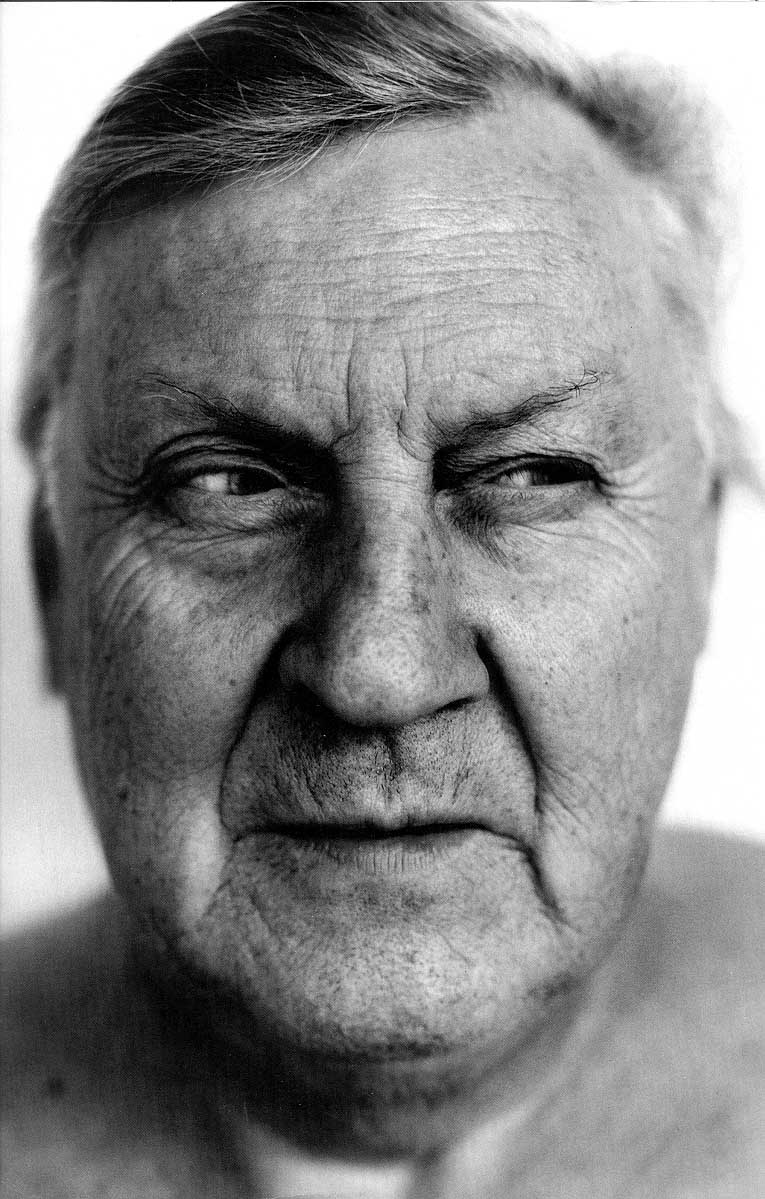
Sven Lundh goes against the grain. He believes that faults matter more than flawlessness. Faults are a sign of the genuine article, he says. Traces of the human hand. The streamlined and the perfect hold little interest for him. Sven built up Källemo, the furniture company. More art than furniture, many would say. Art teaches us to see, says Sven, and in doing so confides to us the very meaning of life.
Sven Lundh’s Eye by Jan Åman
I am not a moral man (though I try to keep my conscience in balance) or a sage; I am neither an aesthete nor a philosopher. I am but a nervous man, by circumstance and by my own deeds; but I am observant.
As my beloved Akutagawa Ryonosuke once said, I have no principles; all I’ve got is nerves. What follows, therefore, has to do with the eye rather than with convictions, including those as to how to run a narrative. One’s eye precedes one’s pen, and I resolve not to let my pen lie about its position.
Joseph Brodsky
(from Watermarks)
1.
One day the telephone rings. It is a message from Småland. I listen with growing astonishment to a story I still cannot quite make sense of. As if it were the most natural thing in the world, the voice on the line tells, with eagerness and enthusiasm, a story about… a folkpark, a people’s park! It speaks of a park somewhere down in the forests of Småland… I listen and learn that the park is a gem, intact with its yellow-painted wooden façades and wide meadows. Even the old signs are still there, as are the paintings from early in the century, Åsa-Nisse and jazz, food hatches and dance floors. But something has stagnated; “the people” no longer find their way to the park. The place remains, but the popular movements that once filled it with life seem to have vanished into something else. All that is left is a monument to a time gone by – but with no anchor in the present. So said the voice, and added: “Wouldn’t that be something to take on, to do something about?” Fresh new winds were needed – not a commercial stunt, but rather something born of contemporary art… The idea, apparently, was that I and my friends in the loose association Inredningar utföres would “take the matter in hand”. I said almost nothing – I didn’t have time – and simply noted that we were hereby invited to travel down to the forests of Småland and take a look. I think I managed to say that we would be glad to come before the receiver was hastily put down. The train ticket was already in the post.
2.
The caller was Sven Lundh. It could not have been anyone else. I don’t believe so – precisely because it was a seriously meant proposal. Consider the situation: here is someone calling, someone I have worked with before and have the greatest respect for, and he begins to tell a story, describes a place, offers a few vague remarks about the circumstances – and suggests that our so-called “group” from Stockholm should do something about it. He wants to give us free rein and free hands – and seems not to consider at all that this might pose any problems. Nothing is said about presentations to politicians and officials. No, the only thing that matters is to get going and reach a result. Sven Lundh had already made up his mind about that. “But,” we tried, “none of us has ever even been to a folkpark!” “Exactly! There you are – that makes you perfect for this assignment, you know what it’s about and can do something new,” Sven replied. Not even the reception – the fact that a gang from Stockholm would come down and remake a folkpark in Vetlanda – troubled the voice on the line in the least. All there was, was an unfailing curiosity about what the result might hold.
3.
Naturally, Sven Lundh knew even before he called what the assignment involved. He knew it was about big things, that we were tumbling straight into something large: our own era’s relationship to our modern history – from the People’s Home to global confusion, from popular movements to an individualised Bingolotto, from Edward Persson to Ernst Billgren, from Ellen Key to Mats Theselius. It was big, so big that it was almost impossible to grasp. But that, of course, was precisely the attraction. Sven saw that. And I think we did too. But unlike him, we found it hard simply to let go and let the ideas flow. We were a little frightened by the size of it.
4.
When we finally stood there looking at what I had heard described on the phone a few days earlier, when I saw the yellow façades, the old signs and the great, beautiful emptiness – the images from the past came clearly into view. It became so obvious that the functionalist villas and the abstract paintings could not be separated from the hip flask by the dance floor and the courses at the People’s House. The literary ambitions existed alongside the political ones. The aesthetic expressions were intertwined with ideology. It all hung together. Everything was part of the same pattern. That was how things worked. In those days…
5.
And that was how things no longer worked. What Sven Lundh wanted us to do was nothing less than take on the memory of a utopia, a utopia that lived and flourished not so long ago, that we ourselves grew up in, but that in a vanishingly short time had been sent to the corner in disgrace. Yes, perhaps Sven even wanted us to create a new one from the remains of the old. He was not after nostalgia: he wanted to have an effect, to move forward, to bring the most “contemporary” artistic discussion into an abandoned folkpark. And I think he truly believed it could work. I don’t really know; we never had time to talk about it, since the whole thing petered out before it had even got started. But I remember that we ourselves stood rather speechless before the task. The park was beautiful in its desolation. It reminded me of a work by the Russian artist Ilya Kabakov, only in Swedish – not as a memorial to Soviet man but to the Swede of the People’s Home.
6.
We were hesitant about touching anything at all. At the same time, we of course saw the sensational in the ambition. But – and this is what I have wanted to arrive at with this story – the initiative is probably a fairly typical example of Sven Lundh’s way of working and acting. However the project might have developed – even if it had been carried all the way through – the decisive artistic act was the one performed through that first phone call, when Sven Lundh rang.
7.
Let us pause there for a while. Sven Lundh is known above all for having brought forth furniture, objects for the home and public spaces – which for various reasons gain renown for something other than function, correct seating and ergonomics. Everything he has done under the name Källemo (I really only know his work from the mid-1980s onward) runs along the borderland between art and furniture, between immaterial values such as beauty, idea, thought and freedom on the one hand – and practical values such as use, function and habit on the other. Sven Lundh is unique. He has been at it for a while, and the designers he has worked with have found their successors, but someone who could take up Sven Lundh’s mantle, or even imitate him as a producer, is harder for me to see. At times I am struck by a strange feeling that Sven Lundh has ended up in a very special position: at once a visionary pioneer blasting holes in the present to drive aesthetic development forward – and a remnant of a time already gone. But such are often the conditions when the results are good.
8.
As a professional, Sven Lundh is one with his “eye”. He sees. He sees people, he sees the quality in objects before anyone else – and he sees connections, large ones, as in the folkpark above. He also gathers around him others with “eyes”. It is hard to put a finger on what it is – an eye for quality… timelessness… integrity… authenticity… No words are quite right, and they hardly can be, since such a quality must result in works by diametrically opposed personalities and therefore expressions. That is why nothing holds Källemo’s collections together except Sven Lundh’s eye. The artists and designers he has come to work with have unusually little to do with one another. Nothing, really. Take any furniture producer at all – even IKEA – and there is greater consistency in the choice of designers than at Källemo. If you look at the surface. Style, you see, is not something that interests Sven Lundh. In him we meet a pronounced individualist. And those he works with must meet that requirement: to be different.
9.
With an “eye” comes intuition, trusting – or depending on – the impulses of the moment. Even though Sven Lundh is both knowledgeable and aware, and knows his historical and contemporary references in art as well as design (he is far too restless not to absorb new impulses all the time), he is no analytical strategist for whom everything he undertakes fits logically together. In this, Sven Lundh truly resembles the image of an artist. When he launches a new piece of furniture or even a new designer, it is just as much a new statement in the ongoing series of statements that shape Sven Lundh’s own “artistry”. That is also why he is aware – and must be – of the gaze of those around him. Sven Lundh wants to be seen and appreciated just like the designers he works with (since I myself have worked with Sven, Mats Theselius and Jonas Bohlin, I have seen a thing or two with my own eyes…). He takes an active role, a sensitive, personal role – exposed and engaged. If the reactions fail to come, he has to come up with something new, turn the game around and play another card. It is the fingertips that steer. It has to be so.
10.
Sven Lundh likes to work. You can see it in his eyes. His life is his work; it never ends. He is said to sleep an hour here and there, often sits in the office in the middle of the night writing letters or doing sums – or stands in the workshop painting or turning wood himself. He is driven by an almost manic obsession, by an impatience that is never allowed to rest. This, too, is something he shares with several of the artists he works with.
11.
There are probably few furniture companies that have released so many “pieces of furniture” that refuse to conform either to Möbelfakta or to exclusive, expensive details. The quality of a Källemo piece does not lie there. It is actually rather amusing that Källemo rose to prominence during the 1980s, a decade that otherwise wallowed in gleaming fittings and shiny lacquered surfaces. They themselves arrived with unplaned planks and concrete. And on top of that they marketed this as something exclusive, sometimes even in small editions and with the “artist’s” signature. That made it exclusive. And this was a case of unusually good timing. There was a superficial need for a reaction at the time, but there was also something deeper: a reaction against the developed, worked-out and finished that our society has refined as idea and thought over a very long period.
12.
Mats Theselius once wrote about modern plastic shavers, that they cannot be understood because you see no joints; that is why they feel “as if dropped from heaven”. It could just as well have been a remark by Sven Lundh. In a society that relies so heavily on product development, finish and form, art – that which can surprise our eye – must stand for something else. When Haupt carved and joined his way straight into his own time in the 18th century, there were neither machines nor computers capable of creating a perfection beyond hands and plane. Kandell’s unplaned planks and Bohlin’s simple forms and materials lead us into our own time – they represent a piece of life in the midst of the all-too-seamless. They are refined because they strip away all ostentation and all superficial ornament. What remains is a gesture, but also a piece of life.
13.
I leaf through a Källemo product brochure. At first I think it confirms what I had planned to write: that nothing but Sven Lundh’s eye brings these different objects and creators together. But then I look again, and something begins to happen. Kandell, Bohlin, Theselius, Chambert, Wretman, Sandell: they all play with a heritage, with a history. It is no coincidence that Sven Lundh chose to reissue some of Gunnar Asplund‘s furniture. And it is no coincidence that it takes on new life when placed alongside the other things Sven Lundh has chosen to produce. Asplund suddenly becomes a historical image of himself. In Theselius, aeroplanes and cars meet cigars and salons. In Bohlin, straight functionalist lines meet Carl Larsson and sentimentality. There is nothing external that binds these objects together. But there is something internal. And that internal thing is Sven Lundh’s inner self.
14.
Furniture and environment. A red thread runs from Strindberg, Ellen Key and Carl Larsson, through the Myrdals, to Sven Lundh. But it is a thread that twists and turns along the way. Perhaps not even its colour is constant, but veers at times towards blue, at other times towards brown. What unites Sven Lundh with his predecessors is the interest in, and understanding of, the fact that furniture creates meaning; that as soon as it is inside the walls of the home, it becomes part of our lives, thoughts and patterns of behaviour. I once wrote about another artist in Sven Lundh’s “stable”, Ernst Billgren, quoting August Strindberg: “He who rents an apartment and is to furnish it walks about composing with creative imagination. He projects his inner self in forms and colours. And when he has got it in order, he can see what he looks like inside, and others with open eyes can see it too.” Furniture is not form; it is also what it is and what it does. It is part of our physical environment, but also of our mental one: as creative memories of ourselves.
15.
Sven Lundh is not only a producer. He is also a polemicist. With heat and emphasis, through quick-witted and poetic phrasing, he has never shied away from sticking his neck out to defend concepts such as quality, durability and timelessness. He readily takes on the role of a classical defender of art and beauty. The quality he speaks of, then, is not primarily upholstery and materials; he seeks a quality of thought and of the eye. A piece of furniture that is like a good work of art: so many-layered and stratified that its meanings shift and widen the longer we live with it.
This text is an excerpt from a longer text written for a book about Sven Lundh published in 1999, in which several other writers also give their view of the phenomenon that is Sven Lundh.
Sven Erik Lundh, born 20 July 1925 in Lagan, died 12 November 2015 in Värnamo.