

Bruno Mathsson Prize 2005 to Johannes Norlander
This year’s Bruno Mathsson Prize of 100,000 kronor is awarded to the young Swedish furniture designer Johannes Norlander. The Mathsson Foundation states in its motivation that Johannes Norlander demonstrates in product design and formal language how the archetypal can be given new dimensions. The sovereign simplicity is enhanced by a subtle humor. With material, form and space, he refines his precise expressions and challenges the viewer to deeper reflections.
Johannes Norlander was born in Gothenburg in 1974. He studied 1993-1995 at CTH in Gothenburg. Attended one year at GDI Konstfack in Stockholm and completed his architecture education 1996-1999 at KTH Architecture in Stockholm. The chairs that primarily led the Mathsson Foundation to award him the prize are called Ingenjören and Dartanjang, names that give literary associations. As a designer, Johannes Norlander speaks about how utility objects have a soul and that he wants to convey poetry in his formal language that awakens thoughts and provides references.
From his own Meccano period, Johannes Norlander progressed, refined his interest in constructions and developed dexterity in his great-grandfather’s workshop, the specialized door factory, which today is run by his father and a brother.
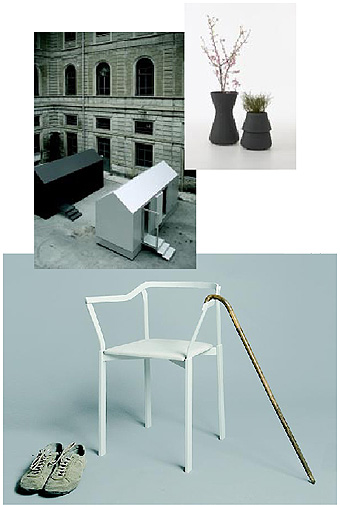 Johannes Norlander’s chairs are called Ingenjören and Dartanjang, names that give literary associations. As a designer, he prefers to talk about how utility objects have a soul. And that he wants to convey poetry in his formal language that awakens thoughts and provides references.
Critical of routine solutions and the lack of knowledge conveyed in impoverished industrial production, characterized by scale and price pressure, he expresses with drastic sharpness: “We love nothing. I miss joy, passion and stringency. There is a lack of life enjoyers in the Swedish design world.”
He thinks the quality bar has gotten stuck at a falukorv level. He himself prefers Parma ham treated according to all the rules of art. According to him, the sovereign form is born from material and technique. His white bookshelf is called Cano and the reference is naturally Meccano, for generations many boys’ introduction to hands-on constructive thinking. Cano has a naive joy built into its pedagogically robust dimensions. From his own Meccano period, Johannes Norlander progressed, refined his interest in constructions and developed his dexterity in his great-grandfather’s workshop, in the specialized door factory, which today is run by father and brother.
When Johannes Norlander almost correctly describes his respect for classical engineering art, which interweaves function and aesthetics, he cannot hide an involvement that borders on passion. After two and a half years at Chalmers School of Architecture, he missed a deeper formal theory and took a “sabbatical semester” at the Department of Graphic Form at Konstfack. The architecture studies were completed at KTH in Stockholm and followed by reality at various architecture offices.
The first personal imprint was created already during study time with the quickly noticed edgy lamp Waves which was part of the Box collection. Design magazine Wallpaper initiated the millennium with various initiatives during furniture fairs in Milan. In 2001, Johannes Norlander received a commission together with Austrian architect Oscar Kaufmann to design a city villa, a narrow “infill” house, a new urban living form, intended to fit into some of the cities’ many gaps. The young audience would gladly move into the space-efficient and simultaneously flexible floor plan for central living, with terrace and pool on the roof. For most, just a dream. The architects made their own project: A and B, two poetically archetypal houses for disciplined living in limited space. Johannes Norlander’s design is distinguished by a strong sense of form that includes a subtle flexibility, expressed for example in the planting vessel Tall which adapts to different sizes or volumes without losing its stringency.
Hedvig Hedqvist
From his own Meccano period, Johannes Norlander progressed, refined his interest in constructions and developed dexterity in his great-grandfather’s workshop, the specialized door factory, which today is run by his father and a brother.
Johannes Norlander’s chairs are called Ingenjören and Dartanjang, names that give literary associations. As a designer, he prefers to talk about how utility objects have a soul. And that he wants to convey poetry in his formal language that awakens thoughts and provides references.
Critical of routine solutions and the lack of knowledge conveyed in impoverished industrial production, characterized by scale and price pressure, he expresses with drastic sharpness: “We love nothing. I miss joy, passion and stringency. There is a lack of life enjoyers in the Swedish design world.”
He thinks the quality bar has gotten stuck at a falukorv level. He himself prefers Parma ham treated according to all the rules of art. According to him, the sovereign form is born from material and technique. His white bookshelf is called Cano and the reference is naturally Meccano, for generations many boys’ introduction to hands-on constructive thinking. Cano has a naive joy built into its pedagogically robust dimensions. From his own Meccano period, Johannes Norlander progressed, refined his interest in constructions and developed his dexterity in his great-grandfather’s workshop, in the specialized door factory, which today is run by father and brother.
When Johannes Norlander almost correctly describes his respect for classical engineering art, which interweaves function and aesthetics, he cannot hide an involvement that borders on passion. After two and a half years at Chalmers School of Architecture, he missed a deeper formal theory and took a “sabbatical semester” at the Department of Graphic Form at Konstfack. The architecture studies were completed at KTH in Stockholm and followed by reality at various architecture offices.
The first personal imprint was created already during study time with the quickly noticed edgy lamp Waves which was part of the Box collection. Design magazine Wallpaper initiated the millennium with various initiatives during furniture fairs in Milan. In 2001, Johannes Norlander received a commission together with Austrian architect Oscar Kaufmann to design a city villa, a narrow “infill” house, a new urban living form, intended to fit into some of the cities’ many gaps. The young audience would gladly move into the space-efficient and simultaneously flexible floor plan for central living, with terrace and pool on the roof. For most, just a dream. The architects made their own project: A and B, two poetically archetypal houses for disciplined living in limited space. Johannes Norlander’s design is distinguished by a strong sense of form that includes a subtle flexibility, expressed for example in the planting vessel Tall which adapts to different sizes or volumes without losing its stringency.
Hedvig Hedqvist
Hedvig Hedqvist
STIFTELSEN KARIN OCH BRUNO MATHSSONS FOND
16 februari 1983 bildades Mathsson-fonden genom donation från Karin och Bruno Mathsson. Fondens ändamål är att främja forskning, utveckling, undervisning och utbildning inom områdena föremål samt inre och yttre miljö. Varje år utdelar fonden Bruno Mathsson-priset på för närvarande 250.000 kronor.

Den ursprungliga styrelsen:
Karin och Bruno Mathsson
Arkitekt Erik Berglund, Möbelinstitutet, Stockholm
Direktör Alf Böe, Munchmuseet, Oslo
Professor Erik Herløw, Köpenhamn
Fil. dr. Ulf Hård af Segerstad, Svenska Dagbladet, Stockholm
Direktör Tapio Periäinen, Konstflitföreningen, Helsingfors
Advokat Håkan Sjöman, Värnamo
Överintendent Dag Widman, Nationalmuseum, Stockholm
Direktör Per Berg, Stockholm, adjungerad som sekreterare
Dagens styrelse:
Formgivare och scenograf Gunilla Allard, Grödinge
Designskribent Hedvig Hedqvist, Stockholm
f.d. Kulturchef Monica Lembke, Värnamo, fondens sekreterare
Museichef vid Vandalorum Elna Svenle
Direktör Dan Thelander, Värnamo
Stiftelsen Karin och Bruno Mathssons Fond,
Box 703, SE-331 27 VÄRNAMO
http://www.mathssonfonden.se/2022/index.htm
 Bruno Mathsson © Bruno Mathsson International
More from Bruno Mathsson:

Superellipse™ table series in New Colours by Piet Hein & Bruno Mathsson
Superellipse™ New Colours for a Modern Classic More than fifty years on, the Superellipse™ table …

Unique shift in the Swedish design world – H&SP and Norrstigen acquire Bruno Mathsson International
Unique shift in the Swedish design world In an unusual and significant transaction within Swedish …

Bruno Mathsson Prize 2026 awarded to Peter Andersson
Swedish furniture and product designer Peter Andersson has been named the recipient of the 2026 …

Maria Jeglinska-Adamczewska awarded Bruno Mathsson Design Residency 2026
Vandalorum and Region Jönköping County are pleased to announce that the recipient of the 2026 …

Peter Karpf – The Danish Designer Who Created Furniture for Calm
Danish Furniture Designer Peter Karpf, 1940-2025 While some early controversial Peter Karpf creations – such …

Bruno Mathsson Prize 40 Years @ Vandalorum
Throughout his life, furniture designer and architect Bruno Mathsson (1907-88) was focused on creating a …
All design & news from Bruno Mathsson: The Swedish Modernist Who Made Sitting a Study →