

The year 2026 marks a century since the birth of architect and designer Verner Panton (1926–1998), one of the most radical and consequential figures in Scandinavian design history.
While many of his contemporaries refined the region’s tradition of craft and natural materials, Panton systematically dismantled it — replacing what he called “grey-beige conformity” with an uncompromising world of colour, synthetic materials and total spatial environments.

Verner Panton in 1968. Copyright © Verner Panton Design AG.
A Rebel With a Drawing Board
Born in Gamtofte, Denmark, Panton studied architecture at the Royal Danish Academy of Fine Arts in Copenhagen. His early career brought him into the studio of Arne Jacobsen, where he contributed to the development of the Ant Chair — one of the defining objects of Danish modernism. Despite his respect for Jacobsen, Panton felt constrained by the prevailing Scandinavian aesthetic and its loyalty to wood and natural materials.
In 1952 he left the Arne Jacobsen studio, converted a Volkswagen van together with a friend from architecture school into a mobile office and drove through Europe to forge connections and explore industrial technologies. New and synthetic materials, wire, enamel, plexiglass, steel and fibreglass were, in Panton’s view, the materials of the future.

Marianne Panton and Christine Fehlbaum sitting on Panton Chairs.
Design by Verner Panton. Copyright © Verner Panton Design AG.
Objects That Changed the Industry
Panton’s best-known furniture and lighting designs remain in continuous production today, a testament to their formal resilience:
Cone Chair (1958) — Originally designed for a restaurant interior, the Cone Chair announced Panton’s departure from conventional furniture logic. Its futurist silhouette, balanced on a single pedestal, rejected four legs as a structural premise.
Panton Chair (1958-1967) — The world’s first single-material, single-piece injection-moulded cantilevered chair. Developed in collaboration with Vitra after years of prototyping, it remains one of the most technically ambitious chairs of the twentieth century.
Flowerpot (1968) — Two reversed hemispheres – one half the size of the other – suspended from a simple stem. Minimal in geometry, immediately readable as a product of its era.
Panthella (1971) — The mushroom-shaped floor and table lamp in which both base and shade function as reflectors. Its organic form anticipated decades of soft, biomorphic design.

Shelving with cupboard sections 1963 designed by Verner Panton.
Copyright © Verner Panton Design AG.
The Total Environment
Panton did not regard individual objects as endpoints. He worked toward what he described as Gesamtkunstwerk — the total artwork — in which furniture, colour, light, texture and architecture operate as a unified system.
His most ambitious manifestation of this idea was Visiona II, created for the German chemical corporation Bayer as part of the Cologne Furniture Fair in 1970. The installation occupied a boat moored on the Rhine and presented an entirely fabricated interior landscape named the “Fantasy Landscape” . Visiona II was the whole exhibition Verner designed for Bayer, and Fantasy Landscape was part of this – for many it was the highlight: approximately 50 square metres of continuous floor, wall and ceiling elements — no corners, no conventional room division — covered in intense yellows, oranges, reds, purples and blues.
Panton described colour not as decoration but as a psychological and architectural instrument. Visitors to Visiona II moved through a spaces designed to affect mood and perception. Sculptural spiral lamps cast coloured light across the surfaces. Soft organic megastructures replaced chairs and sofas, encouraging informal, unconventional postures. Sound reinforced the multisensory character of the installation.
The exhibition had no precedent in furniture exhibition culture and remains one of the most discussed environmental design projects of the twentieth century. A year earlier, Panton had completed the interior of the Spiegel publishing house in Hamburg (1969), another large-scale demonstration of colour and light as organisational principles for commercial architecture.

Modular conceived furniture system series 420 1963 designed by Verner Panton.
Copyright © Verner Panton Design AG.
The Producers: A Catalogue Divided Among Specialists
Panton’s work and legacy is owned and managed by the family-owned company Verner Panton Design AG. Selected designs are produced under licence by high-end manufacturers — the company currently works with more than ten licensees worldwide. The following are among the best known.
Vitra has the license to produce the Panton Chair — the design that defined Panton’s relationship with industrial production. The Swiss manufacturer produces both the Classic version in lacquered rigid foam and the Standard version in polypropylene, as well as the Panton Junior, a proportionally faithful children’s version of the original.
Beyond the chair, Vitra maintains a substantial portion of Panton’s most geometric and sculptural work. The Cone Chair (1958), originally designed for a Danish restaurant and balanced on a rotating steel base, and the Heart Cone Chair — a variant with a backrest suggesting a heart silhouette. The Amoebe Highback extends the Amoebe with a dramatically curved tall back that forms a partial canopy over the sitter. The Visiona Stool (1970), a compact upholstered seat originally part of the Visiona installation in Cologne, completes the seating range.
VERPAN, the Danish producer with the broadest scope across Panton’s catalogue, covers much of his lighting output alongside key furniture series. Lighting includes the VP Globe, Moon Lamp, Spiral and Fun — the pendant lamps featuring layered shell discs in polished sea-shells. In furniture, VERPAN produces, among others, the Series 430 (a chair with circular seat and backrest), the Cloverleaf Sofa (a modular system in the shape of a four-leaf clover), the ergonomic System 1-2-3 series, and the Barboy — a mobile storage unit on castors, originally conceived for domestic bar use. (Verpan has more designs in their collection than the ones mentioned here).
Louis Poulsen focuses on the Panthella series, first designed in 1971. The Danish lighting manufacturer produces the lamp in multiple sizes — 250, 320 and 400 — as well as the battery-powered Panthella Portable, extending the design into contemporary wireless contexts. The shade’s varying materials reflects and redistributes the light in different ways, demonstrating the flexibility of Panton’s original form across material interpretations.
&Tradition holds the rights to the Flowerpot series, produced in versions from VP1 through VP9. Designed in 1968 as a visual emblem of the Flower Power movement, the lamp has been expanded by &Tradition through a wide range of contemporary colours and a cordless portable version for tabletop use. &Tradition also produces the Topan — a spherical pendant that represents one of Panton’s earliest lighting designs. The Topan also comes as a floor and table lamp.
Montana Furniture focuses on Panton’s more structural and modular work. The Panton Wire system — a grid of welded steel wire usable as shelving, table or room divider — The Panton Wire was conceived in 1971 and produced by Lüber. It has been with Montana since the 1990s. Montana also produces the Pantonova, the modular sofa system in steel wire that gained wider recognition after appearing in the 1977 James Bond film The Spy Who Loved Me. In a recent development consistent with Panton’s interest in synthetic materials, Montana has in collaboration with Verner Panton Design AG introduced Panton Wire tabletop panels made from recycled household plastic and ocean waste. Furthermore, Montana Furniture also carries the Wire Stool.
2026: Centenary Exhibitions
The centenary is being marked by major institutional presentations across Europe.
Vitra Design Museum presents in collaboration with Verner Panton Design AG “Verner Panton: Form, Colour, Space” at the Vitra Schaudepot from 23 May 2026 to 9 May 2027. The exhibition covers parts of the Panton collection at Vitra — from the Panton Chair through his lighting and textile designs to several lesser-known architectural projects. A walk-in reconstruction of the Fantasy Landscape from Visiona II (1970) brings his spatial thinking and the spirit of the era into direct physical experience. The show draws on the Vitra Design Museum’s Verner Panton Collection — one of the most significant of its kind — comprising objects, drawings, models and archival materials, and has been developed in close collaboration with Verner Panton Design AG.
Kunstgewerbemuseum Berlin — part of the Staatliche Museen zu Berlin — presents “World of Colours: 100 Years of Verner Panton” from 14 November 2026 to 23 May 2027. They will show a large collection of his designs. The exhibition brings together more than 100 exhibits spanning Panton’s full catalogue: carpets, furniture, ceiling treatments and lighting design. Visitors are invited to engage the work across all senses, entering what the museum describes as a utopian world of form and colour. The exhibition frames Panton’s use of innovative polymers as a decisive break with tradition — synthetic materials in place of wood, chrome-plated steel in place of veneer — and his working method as an unconditional commitment to progress.

Photo: Ola Marton, Bella Center, Denmark, 1998.
Verner Panton did not follow trends. He worked from a fixed conviction that colour could alter human experience, and that design had an obligation to inspire rather than merely function. What makes his output singular — even seventy years after the fact — is that it still reads as forward-looking. His ability to extract comfort from pure geometry has not been surpassed. One hundred years after his birth, that conviction continues to provoke.
Topp image: Verner Panton in his Heart Cone Chair designed in 1958 designed by Verner Panton.
Copyright © Verner Panton Design AG.
More design by Verner Panton:

Carin Panton Presents Verner Panton’s Life and Work at Flokk’s Design Post Köln Stand
In the year Verner Panton would have turned 100, his daughter Carin Panton will speak …
Verner Panton and Louis Poulsen Introduce the Smaller Panthella 400 Floor Lamp Alongside The Originals
The design Louis Poulsen adds two floor lamps to Verner Panton’s Panthella family this autumn. …
Louis Poulsen Reissues the Original Panthella Lamp by Verner Panton
BRINGING BACK THE ORIGINALS Louis Poulsen is proud to bring back the original five Panthella …
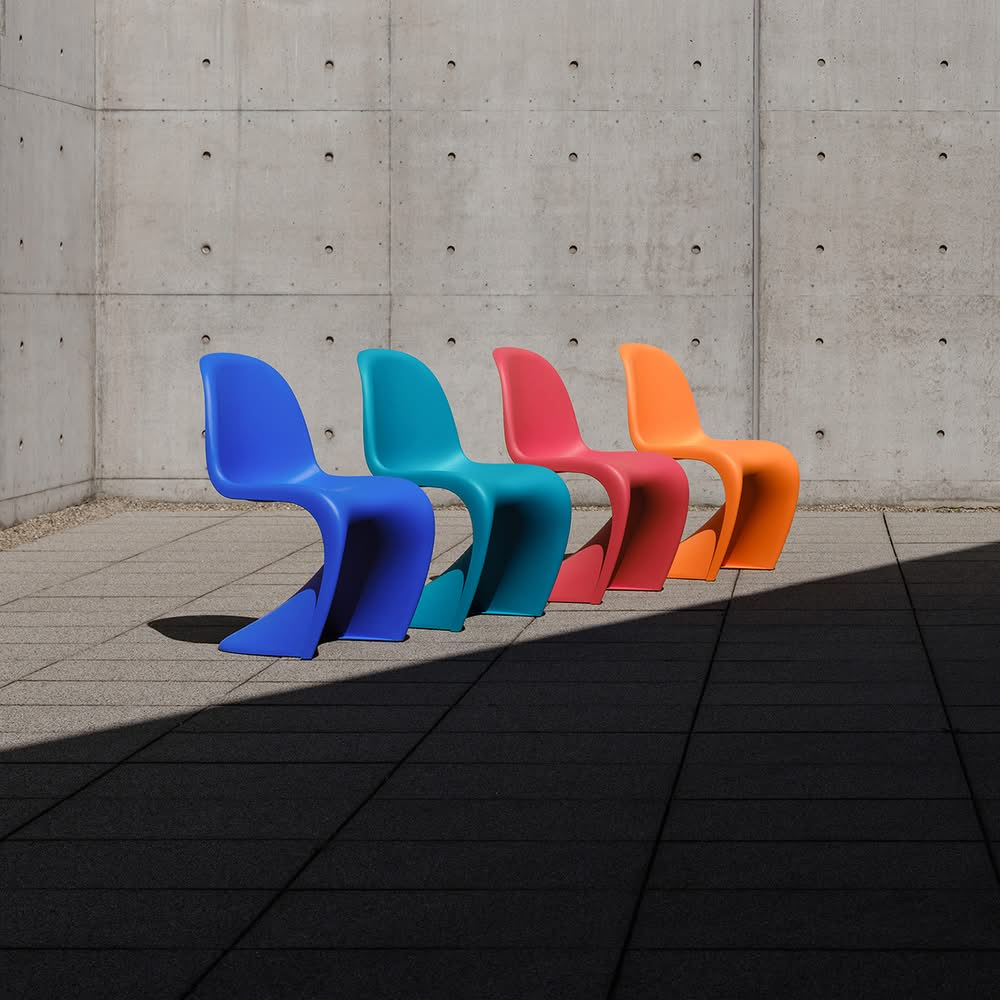
Panton Chair Limited Edition 2026
Verner Panton is known for two things: his innovative design language and his radical use …
System 1-2-3 Chaise Lounge by Verner Panton @ 3dayssofdesign
During 3daysofdesign, VERPAN joins the exhibition Living Verner Panton, presented by Verner Panton Design AG at …
Verner Panton’s Wire series expands by &Tradition
Verner Panton’s Wire series expands with the introduction of a coffee table, bar stool, and …
More design & news from Verner Panton: The Dane Who Made Colour Structural →